
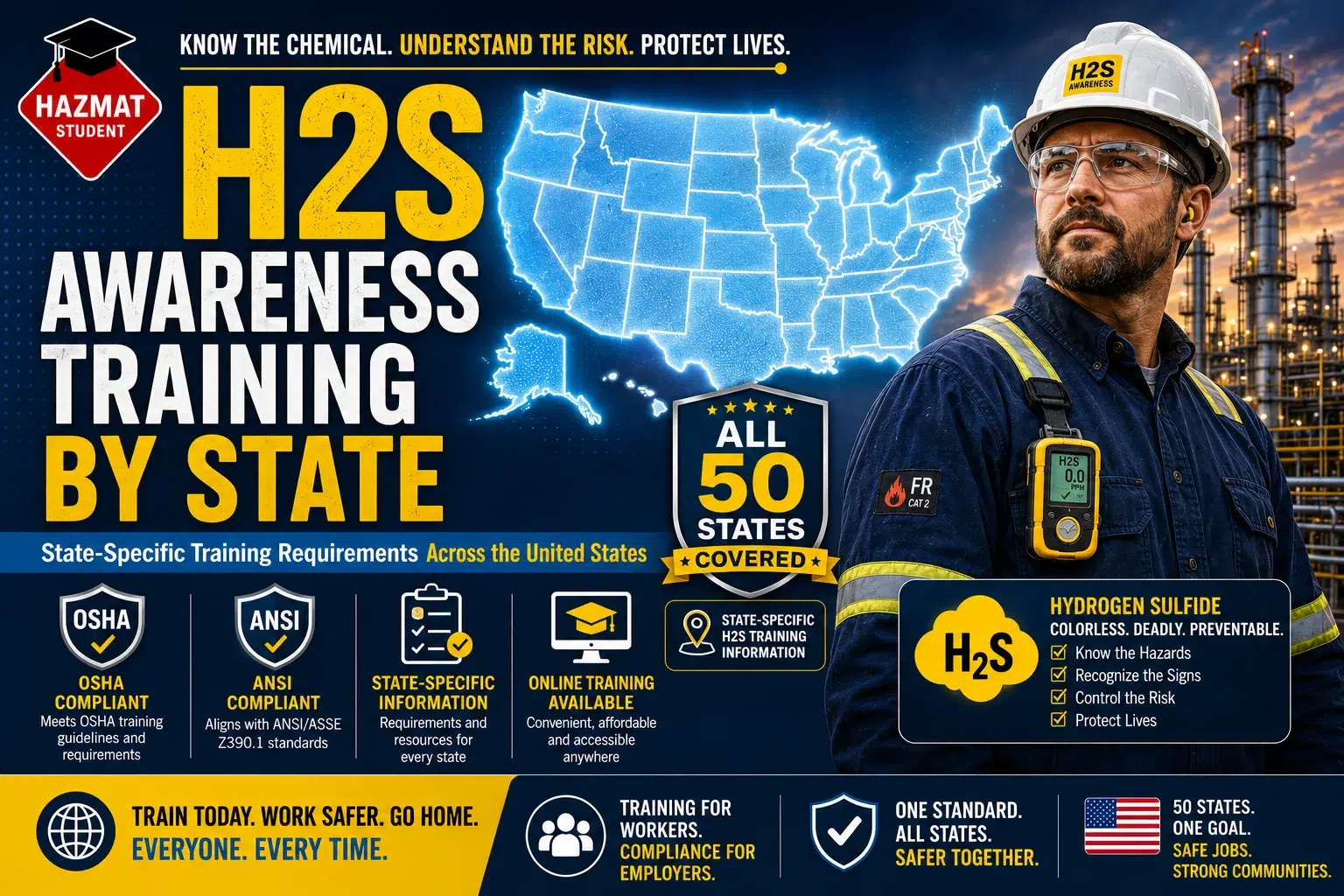
H2S Awareness Training by State
Online OSHA & ANSI Z390.1 hydrogen sulfide training accepted in all 50 states and U.S. territories. Find your state's OSHA jurisdiction and requirements below, then enroll in minutes.
Do H2S Training Requirements Change by State?
For the most part, no. Hydrogen sulfide (H2S) exposure limits are set federally under 29 CFR 1910.1000 Table Z-2 and apply in every state — a 20 ppm ceiling and 50 ppm peak for general industry. Online H2S awareness and ANSI Z390.1 training is accepted in all 50 states and U.S. territories, and the certificate is portable across state lines. What varies is who enforces the rules: 22 states run their own OSHA-approved State Plan, while the rest fall under Federal OSHA. Either way, the federal limits are the floor, and a HazMat Student course meets them. Courses start at $19.95.
Federal OSHA vs. State Plan — what it means for H2S
Twenty-two states and territories operate their own OSHA-approved State Plan (covering private-sector workers); the remaining states regulate private workplaces through Federal OSHA. State Plans must be at least as effective as federal OSHA, so they match or exceed the federal H2S limits — they never make the requirement easier. A handful of states (Connecticut, Illinois, Maine, New Jersey, New York) and the U.S. Virgin Islands run plans that cover government employees only, so private-sector H2S workers there are under Federal OSHA. Bottom line: a compliant course works everywhere.
What's the Same in Every State
- The 20 ppm ceiling / 50 ppm peak H2S limits
- Online training accepted for the knowledge component
- ANSI Z390.1 as the operator-required standard
- Annual refresher expectation
- Certificate portability across state lines
What Can Vary by State
- Whether Federal OSHA or a State Plan enforces
- Added monitoring or recordkeeping in some State-Plan states
- State penalty schedules (still at least as steep)
- Dominant H2S industries (oil & gas vs. wastewater vs. ag)
- The state agency you'd contact with questions
Find Your Next Step
- Open your state in the directory below
- Confirm the tier your employer requires
- Compare the 3 H2S tiers and enroll
- Need a crew trained? Corporate accounts
- Related: all chemical courses
The H2S Exposure Limits That Apply in Every State
These federal limits are the floor in all 50 states. State-Plan states use the same numbers as their minimum and may add to them — so wherever you work, this is what your training is built around.
Source: OSHA Hydrogen Sulfide Standards (osha.gov). NIOSH REL is 10 ppm 10-minute ceiling; ACGIH TLV is 1 ppm 8-hour TWA with 5 ppm STEL.
H2S Awareness Training Requirements by State
Select your state to see who enforces H2S rules there (Federal OSHA or a State Plan), where H2S exposure shows up locally, and how to enroll. Online training is accepted in every state — there is no separate state-issued H2S certificate.
Alabama does not operate its own OSHA-approved State Plan. Workplace safety, including H2S exposure limits and training, is enforced directly by Federal OSHA under 29 CFR 1910.1000 Table Z-2 (general industry) and 29 CFR 1926.55 (construction).
Where H2S exposure shows up in Alabama: municipal and industrial wastewater treatment, pulp and paper mills, and sewer and confined-space crews.
Training availability: Online H2S awareness and ANSI Z390.1 training that meets the federal standard is accepted statewide and nationwide — there is no separate state-issued H2S certificate. Choose the tier your employer or site operator requires.
Alaska operates its own OSHA-approved State Plan (Alaska OSH (AKOSH)), which covers private-sector workers and enforces hydrogen sulfide exposure limits that are at least as strict as federal OSHA — and in some cases stricter. The federal baseline (a 20 ppm ceiling and 50 ppm peak under 29 CFR 1910.1000 Table Z-2) still applies as the floor.
Where H2S exposure shows up in Alaska: oil & gas drilling, refining, and pipeline work, municipal and industrial wastewater treatment, and sewer and confined-space crews.
Training availability: Online H2S awareness and ANSI Z390.1 training that meets the federal standard is accepted statewide and nationwide — there is no separate state-issued H2S certificate. Choose the tier your employer or site operator requires.
Arizona operates its own OSHA-approved State Plan (ADOSH), which covers private-sector workers and enforces hydrogen sulfide exposure limits that are at least as strict as federal OSHA — and in some cases stricter. The federal baseline (a 20 ppm ceiling and 50 ppm peak under 29 CFR 1910.1000 Table Z-2) still applies as the floor.
Where H2S exposure shows up in Arizona: municipal and industrial wastewater treatment, and sewer and confined-space crews.
Training availability: Online H2S awareness and ANSI Z390.1 training that meets the federal standard is accepted statewide and nationwide — there is no separate state-issued H2S certificate. Choose the tier your employer or site operator requires.
Arkansas does not operate its own OSHA-approved State Plan. Workplace safety, including H2S exposure limits and training, is enforced directly by Federal OSHA under 29 CFR 1910.1000 Table Z-2 (general industry) and 29 CFR 1926.55 (construction).
Where H2S exposure shows up in Arkansas: oil & gas drilling, refining, and pipeline work, municipal and industrial wastewater treatment, agriculture (manure pits, lagoons, livestock confinement), and pulp and paper mills.
Training availability: Online H2S awareness and ANSI Z390.1 training that meets the federal standard is accepted statewide and nationwide — there is no separate state-issued H2S certificate. Choose the tier your employer or site operator requires.
California operates its own OSHA-approved State Plan (Cal/OSHA), which covers private-sector workers and enforces hydrogen sulfide exposure limits that are at least as strict as federal OSHA — and in some cases stricter. The federal baseline (a 20 ppm ceiling and 50 ppm peak under 29 CFR 1910.1000 Table Z-2) still applies as the floor.
Where H2S exposure shows up in California: oil & gas drilling, refining, and pipeline work, municipal and industrial wastewater treatment, agriculture (manure pits, lagoons, livestock confinement), and sewer and confined-space crews.
Training availability: Online H2S awareness and ANSI Z390.1 training that meets the federal standard is accepted statewide and nationwide — there is no separate state-issued H2S certificate. Choose the tier your employer or site operator requires.
Colorado does not operate its own OSHA-approved State Plan. Workplace safety, including H2S exposure limits and training, is enforced directly by Federal OSHA under 29 CFR 1910.1000 Table Z-2 (general industry) and 29 CFR 1926.55 (construction).
Where H2S exposure shows up in Colorado: oil & gas drilling, refining, and pipeline work, municipal and industrial wastewater treatment, and sewer and confined-space crews.
Training availability: Online H2S awareness and ANSI Z390.1 training that meets the federal standard is accepted statewide and nationwide — there is no separate state-issued H2S certificate. Choose the tier your employer or site operator requires.
Connecticut runs an OSHA-approved State Plan that covers state and local government employees only — private-sector workplaces (oil & gas, wastewater, industrial) are regulated directly by Federal OSHA under 29 CFR 1910.1000 Table Z-2.
Where H2S exposure shows up in Connecticut: municipal and industrial wastewater treatment, and sewer and confined-space crews.
Training availability: Online H2S awareness and ANSI Z390.1 training that meets the federal standard is accepted statewide and nationwide — there is no separate state-issued H2S certificate. Choose the tier your employer or site operator requires.
Delaware does not operate its own OSHA-approved State Plan. Workplace safety, including H2S exposure limits and training, is enforced directly by Federal OSHA under 29 CFR 1910.1000 Table Z-2 (general industry) and 29 CFR 1926.55 (construction).
Where H2S exposure shows up in Delaware: municipal and industrial wastewater treatment, and sewer and confined-space crews.
Training availability: Online H2S awareness and ANSI Z390.1 training that meets the federal standard is accepted statewide and nationwide — there is no separate state-issued H2S certificate. Choose the tier your employer or site operator requires.
District of Columbia does not operate its own OSHA-approved State Plan. Workplace safety, including H2S exposure limits and training, is enforced directly by Federal OSHA under 29 CFR 1910.1000 Table Z-2 (general industry) and 29 CFR 1926.55 (construction).
Where H2S exposure shows up in District of Columbia: municipal and industrial wastewater treatment, and sewer and confined-space crews.
Training availability: Online H2S awareness and ANSI Z390.1 training that meets the federal standard is accepted statewide and nationwide — there is no separate state-issued H2S certificate. Choose the tier your employer or site operator requires.
Florida does not operate its own OSHA-approved State Plan. Workplace safety, including H2S exposure limits and training, is enforced directly by Federal OSHA under 29 CFR 1910.1000 Table Z-2 (general industry) and 29 CFR 1926.55 (construction).
Where H2S exposure shows up in Florida: municipal and industrial wastewater treatment, pulp and paper mills, and sewer and confined-space crews.
Training availability: Online H2S awareness and ANSI Z390.1 training that meets the federal standard is accepted statewide and nationwide — there is no separate state-issued H2S certificate. Choose the tier your employer or site operator requires.
Georgia does not operate its own OSHA-approved State Plan. Workplace safety, including H2S exposure limits and training, is enforced directly by Federal OSHA under 29 CFR 1910.1000 Table Z-2 (general industry) and 29 CFR 1926.55 (construction).
Where H2S exposure shows up in Georgia: municipal and industrial wastewater treatment, pulp and paper mills, and sewer and confined-space crews.
Training availability: Online H2S awareness and ANSI Z390.1 training that meets the federal standard is accepted statewide and nationwide — there is no separate state-issued H2S certificate. Choose the tier your employer or site operator requires.
Hawaii operates its own OSHA-approved State Plan (HIOSH), which covers private-sector workers and enforces hydrogen sulfide exposure limits that are at least as strict as federal OSHA — and in some cases stricter. The federal baseline (a 20 ppm ceiling and 50 ppm peak under 29 CFR 1910.1000 Table Z-2) still applies as the floor.
Where H2S exposure shows up in Hawaii: municipal and industrial wastewater treatment, and sewer and confined-space crews.
Training availability: Online H2S awareness and ANSI Z390.1 training that meets the federal standard is accepted statewide and nationwide — there is no separate state-issued H2S certificate. Choose the tier your employer or site operator requires.
Idaho does not operate its own OSHA-approved State Plan. Workplace safety, including H2S exposure limits and training, is enforced directly by Federal OSHA under 29 CFR 1910.1000 Table Z-2 (general industry) and 29 CFR 1926.55 (construction).
Where H2S exposure shows up in Idaho: municipal and industrial wastewater treatment, agriculture (manure pits, lagoons, livestock confinement), and sewer and confined-space crews.
Training availability: Online H2S awareness and ANSI Z390.1 training that meets the federal standard is accepted statewide and nationwide — there is no separate state-issued H2S certificate. Choose the tier your employer or site operator requires.
Illinois runs an OSHA-approved State Plan that covers state and local government employees only — private-sector workplaces (oil & gas, wastewater, industrial) are regulated directly by Federal OSHA under 29 CFR 1910.1000 Table Z-2.
Where H2S exposure shows up in Illinois: refining and petrochemical plants, municipal and industrial wastewater treatment, and sewer and confined-space crews.
Training availability: Online H2S awareness and ANSI Z390.1 training that meets the federal standard is accepted statewide and nationwide — there is no separate state-issued H2S certificate. Choose the tier your employer or site operator requires.
Indiana operates its own OSHA-approved State Plan (IOSHA), which covers private-sector workers and enforces hydrogen sulfide exposure limits that are at least as strict as federal OSHA — and in some cases stricter. The federal baseline (a 20 ppm ceiling and 50 ppm peak under 29 CFR 1910.1000 Table Z-2) still applies as the floor.
Where H2S exposure shows up in Indiana: refining and petrochemical plants, municipal and industrial wastewater treatment, agriculture (manure pits, lagoons, livestock confinement), and sewer and confined-space crews.
Training availability: Online H2S awareness and ANSI Z390.1 training that meets the federal standard is accepted statewide and nationwide — there is no separate state-issued H2S certificate. Choose the tier your employer or site operator requires.
Iowa operates its own OSHA-approved State Plan (Iowa OSHA), which covers private-sector workers and enforces hydrogen sulfide exposure limits that are at least as strict as federal OSHA — and in some cases stricter. The federal baseline (a 20 ppm ceiling and 50 ppm peak under 29 CFR 1910.1000 Table Z-2) still applies as the floor.
Where H2S exposure shows up in Iowa: municipal and industrial wastewater treatment, agriculture (manure pits, lagoons, livestock confinement), and sewer and confined-space crews.
Training availability: Online H2S awareness and ANSI Z390.1 training that meets the federal standard is accepted statewide and nationwide — there is no separate state-issued H2S certificate. Choose the tier your employer or site operator requires.
Kansas does not operate its own OSHA-approved State Plan. Workplace safety, including H2S exposure limits and training, is enforced directly by Federal OSHA under 29 CFR 1910.1000 Table Z-2 (general industry) and 29 CFR 1926.55 (construction).
Where H2S exposure shows up in Kansas: oil & gas drilling, refining, and pipeline work, municipal and industrial wastewater treatment, agriculture (manure pits, lagoons, livestock confinement), and sewer and confined-space crews.
Training availability: Online H2S awareness and ANSI Z390.1 training that meets the federal standard is accepted statewide and nationwide — there is no separate state-issued H2S certificate. Choose the tier your employer or site operator requires.
Kentucky operates its own OSHA-approved State Plan (Kentucky OSH), which covers private-sector workers and enforces hydrogen sulfide exposure limits that are at least as strict as federal OSHA — and in some cases stricter. The federal baseline (a 20 ppm ceiling and 50 ppm peak under 29 CFR 1910.1000 Table Z-2) still applies as the floor.
Where H2S exposure shows up in Kentucky: municipal and industrial wastewater treatment, agriculture (manure pits, lagoons, livestock confinement), and sewer and confined-space crews.
Training availability: Online H2S awareness and ANSI Z390.1 training that meets the federal standard is accepted statewide and nationwide — there is no separate state-issued H2S certificate. Choose the tier your employer or site operator requires.
Louisiana does not operate its own OSHA-approved State Plan. Workplace safety, including H2S exposure limits and training, is enforced directly by Federal OSHA under 29 CFR 1910.1000 Table Z-2 (general industry) and 29 CFR 1926.55 (construction).
Where H2S exposure shows up in Louisiana: oil & gas drilling, refining, and pipeline work, municipal and industrial wastewater treatment, pulp and paper mills, and sewer and confined-space crews.
Training availability: Online H2S awareness and ANSI Z390.1 training that meets the federal standard is accepted statewide and nationwide — there is no separate state-issued H2S certificate. Choose the tier your employer or site operator requires.
Maine runs an OSHA-approved State Plan that covers state and local government employees only — private-sector workplaces (oil & gas, wastewater, industrial) are regulated directly by Federal OSHA under 29 CFR 1910.1000 Table Z-2.
Where H2S exposure shows up in Maine: municipal and industrial wastewater treatment, pulp and paper mills, and sewer and confined-space crews.
Training availability: Online H2S awareness and ANSI Z390.1 training that meets the federal standard is accepted statewide and nationwide — there is no separate state-issued H2S certificate. Choose the tier your employer or site operator requires.
Maryland operates its own OSHA-approved State Plan (Maryland MOSH), which covers private-sector workers and enforces hydrogen sulfide exposure limits that are at least as strict as federal OSHA — and in some cases stricter. The federal baseline (a 20 ppm ceiling and 50 ppm peak under 29 CFR 1910.1000 Table Z-2) still applies as the floor.
Where H2S exposure shows up in Maryland: municipal and industrial wastewater treatment, and sewer and confined-space crews.
Training availability: Online H2S awareness and ANSI Z390.1 training that meets the federal standard is accepted statewide and nationwide — there is no separate state-issued H2S certificate. Choose the tier your employer or site operator requires.
Massachusetts does not operate its own OSHA-approved State Plan. Workplace safety, including H2S exposure limits and training, is enforced directly by Federal OSHA under 29 CFR 1910.1000 Table Z-2 (general industry) and 29 CFR 1926.55 (construction).
Where H2S exposure shows up in Massachusetts: municipal and industrial wastewater treatment, and sewer and confined-space crews.
Training availability: Online H2S awareness and ANSI Z390.1 training that meets the federal standard is accepted statewide and nationwide — there is no separate state-issued H2S certificate. Choose the tier your employer or site operator requires.
Michigan operates its own OSHA-approved State Plan (MIOSHA), which covers private-sector workers and enforces hydrogen sulfide exposure limits that are at least as strict as federal OSHA — and in some cases stricter. The federal baseline (a 20 ppm ceiling and 50 ppm peak under 29 CFR 1910.1000 Table Z-2) still applies as the floor.
Where H2S exposure shows up in Michigan: municipal and industrial wastewater treatment, and sewer and confined-space crews.
Training availability: Online H2S awareness and ANSI Z390.1 training that meets the federal standard is accepted statewide and nationwide — there is no separate state-issued H2S certificate. Choose the tier your employer or site operator requires.
Minnesota operates its own OSHA-approved State Plan (Minnesota OSHA), which covers private-sector workers and enforces hydrogen sulfide exposure limits that are at least as strict as federal OSHA — and in some cases stricter. The federal baseline (a 20 ppm ceiling and 50 ppm peak under 29 CFR 1910.1000 Table Z-2) still applies as the floor.
Where H2S exposure shows up in Minnesota: municipal and industrial wastewater treatment, agriculture (manure pits, lagoons, livestock confinement), and sewer and confined-space crews.
Training availability: Online H2S awareness and ANSI Z390.1 training that meets the federal standard is accepted statewide and nationwide — there is no separate state-issued H2S certificate. Choose the tier your employer or site operator requires.
Mississippi does not operate its own OSHA-approved State Plan. Workplace safety, including H2S exposure limits and training, is enforced directly by Federal OSHA under 29 CFR 1910.1000 Table Z-2 (general industry) and 29 CFR 1926.55 (construction).
Where H2S exposure shows up in Mississippi: oil & gas drilling, refining, and pipeline work, municipal and industrial wastewater treatment, pulp and paper mills, and sewer and confined-space crews.
Training availability: Online H2S awareness and ANSI Z390.1 training that meets the federal standard is accepted statewide and nationwide — there is no separate state-issued H2S certificate. Choose the tier your employer or site operator requires.
Missouri does not operate its own OSHA-approved State Plan. Workplace safety, including H2S exposure limits and training, is enforced directly by Federal OSHA under 29 CFR 1910.1000 Table Z-2 (general industry) and 29 CFR 1926.55 (construction).
Where H2S exposure shows up in Missouri: municipal and industrial wastewater treatment, agriculture (manure pits, lagoons, livestock confinement), and sewer and confined-space crews.
Training availability: Online H2S awareness and ANSI Z390.1 training that meets the federal standard is accepted statewide and nationwide — there is no separate state-issued H2S certificate. Choose the tier your employer or site operator requires.
Montana does not operate its own OSHA-approved State Plan. Workplace safety, including H2S exposure limits and training, is enforced directly by Federal OSHA under 29 CFR 1910.1000 Table Z-2 (general industry) and 29 CFR 1926.55 (construction).
Where H2S exposure shows up in Montana: oil & gas drilling, refining, and pipeline work, municipal and industrial wastewater treatment, and sewer and confined-space crews.
Training availability: Online H2S awareness and ANSI Z390.1 training that meets the federal standard is accepted statewide and nationwide — there is no separate state-issued H2S certificate. Choose the tier your employer or site operator requires.
Nebraska does not operate its own OSHA-approved State Plan. Workplace safety, including H2S exposure limits and training, is enforced directly by Federal OSHA under 29 CFR 1910.1000 Table Z-2 (general industry) and 29 CFR 1926.55 (construction).
Where H2S exposure shows up in Nebraska: municipal and industrial wastewater treatment, agriculture (manure pits, lagoons, livestock confinement), and sewer and confined-space crews.
Training availability: Online H2S awareness and ANSI Z390.1 training that meets the federal standard is accepted statewide and nationwide — there is no separate state-issued H2S certificate. Choose the tier your employer or site operator requires.
Nevada operates its own OSHA-approved State Plan (Nevada OSHA), which covers private-sector workers and enforces hydrogen sulfide exposure limits that are at least as strict as federal OSHA — and in some cases stricter. The federal baseline (a 20 ppm ceiling and 50 ppm peak under 29 CFR 1910.1000 Table Z-2) still applies as the floor.
Where H2S exposure shows up in Nevada: municipal and industrial wastewater treatment, and sewer and confined-space crews.
Training availability: Online H2S awareness and ANSI Z390.1 training that meets the federal standard is accepted statewide and nationwide — there is no separate state-issued H2S certificate. Choose the tier your employer or site operator requires.
New Hampshire does not operate its own OSHA-approved State Plan. Workplace safety, including H2S exposure limits and training, is enforced directly by Federal OSHA under 29 CFR 1910.1000 Table Z-2 (general industry) and 29 CFR 1926.55 (construction).
Where H2S exposure shows up in New Hampshire: municipal and industrial wastewater treatment, and sewer and confined-space crews.
Training availability: Online H2S awareness and ANSI Z390.1 training that meets the federal standard is accepted statewide and nationwide — there is no separate state-issued H2S certificate. Choose the tier your employer or site operator requires.
New Jersey runs an OSHA-approved State Plan that covers state and local government employees only — private-sector workplaces (oil & gas, wastewater, industrial) are regulated directly by Federal OSHA under 29 CFR 1910.1000 Table Z-2.
Where H2S exposure shows up in New Jersey: refining and petrochemical plants, municipal and industrial wastewater treatment, and sewer and confined-space crews.
Training availability: Online H2S awareness and ANSI Z390.1 training that meets the federal standard is accepted statewide and nationwide — there is no separate state-issued H2S certificate. Choose the tier your employer or site operator requires.
New Mexico operates its own OSHA-approved State Plan (New Mexico OHSB), which covers private-sector workers and enforces hydrogen sulfide exposure limits that are at least as strict as federal OSHA — and in some cases stricter. The federal baseline (a 20 ppm ceiling and 50 ppm peak under 29 CFR 1910.1000 Table Z-2) still applies as the floor.
Where H2S exposure shows up in New Mexico: oil & gas drilling, refining, and pipeline work, municipal and industrial wastewater treatment, and sewer and confined-space crews.
Training availability: Online H2S awareness and ANSI Z390.1 training that meets the federal standard is accepted statewide and nationwide — there is no separate state-issued H2S certificate. Choose the tier your employer or site operator requires.
New York runs an OSHA-approved State Plan that covers state and local government employees only — private-sector workplaces (oil & gas, wastewater, industrial) are regulated directly by Federal OSHA under 29 CFR 1910.1000 Table Z-2.
Where H2S exposure shows up in New York: municipal and industrial wastewater treatment, and sewer and confined-space crews.
Training availability: Online H2S awareness and ANSI Z390.1 training that meets the federal standard is accepted statewide and nationwide — there is no separate state-issued H2S certificate. Choose the tier your employer or site operator requires.
North Carolina operates its own OSHA-approved State Plan (NC OSH), which covers private-sector workers and enforces hydrogen sulfide exposure limits that are at least as strict as federal OSHA — and in some cases stricter. The federal baseline (a 20 ppm ceiling and 50 ppm peak under 29 CFR 1910.1000 Table Z-2) still applies as the floor.
Where H2S exposure shows up in North Carolina: municipal and industrial wastewater treatment, agriculture (manure pits, lagoons, livestock confinement), and sewer and confined-space crews.
Training availability: Online H2S awareness and ANSI Z390.1 training that meets the federal standard is accepted statewide and nationwide — there is no separate state-issued H2S certificate. Choose the tier your employer or site operator requires.
North Dakota does not operate its own OSHA-approved State Plan. Workplace safety, including H2S exposure limits and training, is enforced directly by Federal OSHA under 29 CFR 1910.1000 Table Z-2 (general industry) and 29 CFR 1926.55 (construction).
Where H2S exposure shows up in North Dakota: oil & gas drilling, refining, and pipeline work, municipal and industrial wastewater treatment, and sewer and confined-space crews.
Training availability: Online H2S awareness and ANSI Z390.1 training that meets the federal standard is accepted statewide and nationwide — there is no separate state-issued H2S certificate. Choose the tier your employer or site operator requires.
Ohio does not operate its own OSHA-approved State Plan. Workplace safety, including H2S exposure limits and training, is enforced directly by Federal OSHA under 29 CFR 1910.1000 Table Z-2 (general industry) and 29 CFR 1926.55 (construction).
Where H2S exposure shows up in Ohio: oil & gas drilling, refining, and pipeline work, municipal and industrial wastewater treatment, and sewer and confined-space crews.
Training availability: Online H2S awareness and ANSI Z390.1 training that meets the federal standard is accepted statewide and nationwide — there is no separate state-issued H2S certificate. Choose the tier your employer or site operator requires.
Oklahoma does not operate its own OSHA-approved State Plan. Workplace safety, including H2S exposure limits and training, is enforced directly by Federal OSHA under 29 CFR 1910.1000 Table Z-2 (general industry) and 29 CFR 1926.55 (construction).
Where H2S exposure shows up in Oklahoma: oil & gas drilling, refining, and pipeline work, municipal and industrial wastewater treatment, and sewer and confined-space crews.
Training availability: Online H2S awareness and ANSI Z390.1 training that meets the federal standard is accepted statewide and nationwide — there is no separate state-issued H2S certificate. Choose the tier your employer or site operator requires.
Oregon operates its own OSHA-approved State Plan (Oregon OSHA), which covers private-sector workers and enforces hydrogen sulfide exposure limits that are at least as strict as federal OSHA — and in some cases stricter. The federal baseline (a 20 ppm ceiling and 50 ppm peak under 29 CFR 1910.1000 Table Z-2) still applies as the floor.
Where H2S exposure shows up in Oregon: municipal and industrial wastewater treatment, pulp and paper mills, and sewer and confined-space crews.
Training availability: Online H2S awareness and ANSI Z390.1 training that meets the federal standard is accepted statewide and nationwide — there is no separate state-issued H2S certificate. Choose the tier your employer or site operator requires.
Pennsylvania does not operate its own OSHA-approved State Plan. Workplace safety, including H2S exposure limits and training, is enforced directly by Federal OSHA under 29 CFR 1910.1000 Table Z-2 (general industry) and 29 CFR 1926.55 (construction).
Where H2S exposure shows up in Pennsylvania: oil & gas drilling, refining, and pipeline work, municipal and industrial wastewater treatment, and sewer and confined-space crews.
Training availability: Online H2S awareness and ANSI Z390.1 training that meets the federal standard is accepted statewide and nationwide — there is no separate state-issued H2S certificate. Choose the tier your employer or site operator requires.
Rhode Island does not operate its own OSHA-approved State Plan. Workplace safety, including H2S exposure limits and training, is enforced directly by Federal OSHA under 29 CFR 1910.1000 Table Z-2 (general industry) and 29 CFR 1926.55 (construction).
Where H2S exposure shows up in Rhode Island: municipal and industrial wastewater treatment, and sewer and confined-space crews.
Training availability: Online H2S awareness and ANSI Z390.1 training that meets the federal standard is accepted statewide and nationwide — there is no separate state-issued H2S certificate. Choose the tier your employer or site operator requires.
South Carolina operates its own OSHA-approved State Plan (SC OSHA), which covers private-sector workers and enforces hydrogen sulfide exposure limits that are at least as strict as federal OSHA — and in some cases stricter. The federal baseline (a 20 ppm ceiling and 50 ppm peak under 29 CFR 1910.1000 Table Z-2) still applies as the floor.
Where H2S exposure shows up in South Carolina: municipal and industrial wastewater treatment, pulp and paper mills, and sewer and confined-space crews.
Training availability: Online H2S awareness and ANSI Z390.1 training that meets the federal standard is accepted statewide and nationwide — there is no separate state-issued H2S certificate. Choose the tier your employer or site operator requires.
South Dakota does not operate its own OSHA-approved State Plan. Workplace safety, including H2S exposure limits and training, is enforced directly by Federal OSHA under 29 CFR 1910.1000 Table Z-2 (general industry) and 29 CFR 1926.55 (construction).
Where H2S exposure shows up in South Dakota: municipal and industrial wastewater treatment, agriculture (manure pits, lagoons, livestock confinement), and sewer and confined-space crews.
Training availability: Online H2S awareness and ANSI Z390.1 training that meets the federal standard is accepted statewide and nationwide — there is no separate state-issued H2S certificate. Choose the tier your employer or site operator requires.
Tennessee operates its own OSHA-approved State Plan (TOSHA), which covers private-sector workers and enforces hydrogen sulfide exposure limits that are at least as strict as federal OSHA — and in some cases stricter. The federal baseline (a 20 ppm ceiling and 50 ppm peak under 29 CFR 1910.1000 Table Z-2) still applies as the floor.
Where H2S exposure shows up in Tennessee: municipal and industrial wastewater treatment, and sewer and confined-space crews.
Training availability: Online H2S awareness and ANSI Z390.1 training that meets the federal standard is accepted statewide and nationwide — there is no separate state-issued H2S certificate. Choose the tier your employer or site operator requires.
Texas does not operate its own OSHA-approved State Plan. Workplace safety, including H2S exposure limits and training, is enforced directly by Federal OSHA under 29 CFR 1910.1000 Table Z-2 (general industry) and 29 CFR 1926.55 (construction).
Where H2S exposure shows up in Texas: oil & gas drilling, refining, and pipeline work, municipal and industrial wastewater treatment, agriculture (manure pits, lagoons, livestock confinement), and sewer and confined-space crews.
Training availability: Online H2S awareness and ANSI Z390.1 training that meets the federal standard is accepted statewide and nationwide — there is no separate state-issued H2S certificate. Choose the tier your employer or site operator requires.
Utah operates its own OSHA-approved State Plan (Utah OSH (UOSH)), which covers private-sector workers and enforces hydrogen sulfide exposure limits that are at least as strict as federal OSHA — and in some cases stricter. The federal baseline (a 20 ppm ceiling and 50 ppm peak under 29 CFR 1910.1000 Table Z-2) still applies as the floor.
Where H2S exposure shows up in Utah: oil & gas drilling, refining, and pipeline work, municipal and industrial wastewater treatment, and sewer and confined-space crews.
Training availability: Online H2S awareness and ANSI Z390.1 training that meets the federal standard is accepted statewide and nationwide — there is no separate state-issued H2S certificate. Choose the tier your employer or site operator requires.
Vermont operates its own OSHA-approved State Plan (VOSHA), which covers private-sector workers and enforces hydrogen sulfide exposure limits that are at least as strict as federal OSHA — and in some cases stricter. The federal baseline (a 20 ppm ceiling and 50 ppm peak under 29 CFR 1910.1000 Table Z-2) still applies as the floor.
Where H2S exposure shows up in Vermont: municipal and industrial wastewater treatment, agriculture (manure pits, lagoons, livestock confinement), and sewer and confined-space crews.
Training availability: Online H2S awareness and ANSI Z390.1 training that meets the federal standard is accepted statewide and nationwide — there is no separate state-issued H2S certificate. Choose the tier your employer or site operator requires.
Virginia operates its own OSHA-approved State Plan (VOSH), which covers private-sector workers and enforces hydrogen sulfide exposure limits that are at least as strict as federal OSHA — and in some cases stricter. The federal baseline (a 20 ppm ceiling and 50 ppm peak under 29 CFR 1910.1000 Table Z-2) still applies as the floor.
Where H2S exposure shows up in Virginia: municipal and industrial wastewater treatment, pulp and paper mills, and sewer and confined-space crews.
Training availability: Online H2S awareness and ANSI Z390.1 training that meets the federal standard is accepted statewide and nationwide — there is no separate state-issued H2S certificate. Choose the tier your employer or site operator requires.
Washington operates its own OSHA-approved State Plan (Washington DOSH (L&I)), which covers private-sector workers and enforces hydrogen sulfide exposure limits that are at least as strict as federal OSHA — and in some cases stricter. The federal baseline (a 20 ppm ceiling and 50 ppm peak under 29 CFR 1910.1000 Table Z-2) still applies as the floor.
Where H2S exposure shows up in Washington: refining and petrochemical plants, municipal and industrial wastewater treatment, pulp and paper mills, and sewer and confined-space crews.
Training availability: Online H2S awareness and ANSI Z390.1 training that meets the federal standard is accepted statewide and nationwide — there is no separate state-issued H2S certificate. Choose the tier your employer or site operator requires.
West Virginia does not operate its own OSHA-approved State Plan. Workplace safety, including H2S exposure limits and training, is enforced directly by Federal OSHA under 29 CFR 1910.1000 Table Z-2 (general industry) and 29 CFR 1926.55 (construction).
Where H2S exposure shows up in West Virginia: oil & gas drilling, refining, and pipeline work, municipal and industrial wastewater treatment, and sewer and confined-space crews.
Training availability: Online H2S awareness and ANSI Z390.1 training that meets the federal standard is accepted statewide and nationwide — there is no separate state-issued H2S certificate. Choose the tier your employer or site operator requires.
Wisconsin does not operate its own OSHA-approved State Plan. Workplace safety, including H2S exposure limits and training, is enforced directly by Federal OSHA under 29 CFR 1910.1000 Table Z-2 (general industry) and 29 CFR 1926.55 (construction).
Where H2S exposure shows up in Wisconsin: municipal and industrial wastewater treatment, agriculture (manure pits, lagoons, livestock confinement), pulp and paper mills, and sewer and confined-space crews.
Training availability: Online H2S awareness and ANSI Z390.1 training that meets the federal standard is accepted statewide and nationwide — there is no separate state-issued H2S certificate. Choose the tier your employer or site operator requires.
Wyoming operates its own OSHA-approved State Plan (Wyoming OSHA), which covers private-sector workers and enforces hydrogen sulfide exposure limits that are at least as strict as federal OSHA — and in some cases stricter. The federal baseline (a 20 ppm ceiling and 50 ppm peak under 29 CFR 1910.1000 Table Z-2) still applies as the floor.
Where H2S exposure shows up in Wyoming: oil & gas drilling, refining, and pipeline work, municipal and industrial wastewater treatment, and sewer and confined-space crews.
Training availability: Online H2S awareness and ANSI Z390.1 training that meets the federal standard is accepted statewide and nationwide — there is no separate state-issued H2S certificate. Choose the tier your employer or site operator requires.
U.S. Territories
Puerto Rico operates its own OSHA-approved State Plan (PR OSHA) covering private-sector and public workers. H2S exposure limits are at least as strict as the federal 29 CFR 1910.1000 Table Z-2 baseline.
Where H2S exposure shows up: petrochemical and pharmaceutical plants, municipal wastewater treatment, and port and confined-space operations.
Training availability: Online H2S awareness and ANSI Z390.1 training meeting the federal standard is accepted territory-wide.
Guam, American Samoa, and the Northern Mariana Islands are covered directly by Federal OSHA. The U.S. Virgin Islands runs a State Plan covering public employees only, so private-sector workplaces there are also under Federal OSHA. In every case the federal H2S limits under 29 CFR 1910.1000 Table Z-2 apply.
Where H2S exposure shows up: port and shipyard operations, fuel storage and power generation, and municipal wastewater systems.
Training availability: Online H2S awareness and ANSI Z390.1 training meeting the federal standard is accepted across all U.S. territories.
How to Get H2S Certified in Your State
- Confirm who enforces in your state
Open your state in the directory above. Whether you're under Federal OSHA or a State Plan, the federal H2S limits are the baseline and online training is accepted statewide.
- Check the tier your employer or operator requires
Most oil & gas, refinery, and pipeline operators require ANSI Z390.1, included in the 4-Hour OSHA/ANSI and 6-Hour Certification tiers. Wastewater, agriculture, and general industry often accept the 2-Hour OSHA tier. Ask your safety officer or contractor pre-qualification system (ISN, Avetta, PEC).
- Pick your tier and enroll through the OTS portal
Click Enroll Now to open the OTS portal. After logging in, click Signup for Course, search for Hydrogen Sulfide (H2S), and click Select for your tier. Compare all three H2S tiers here.
- Complete the self-paced course and download your certificate
Log in from any device, finish at your own pace, pass the exam, and your certificate is available instantly — valid and recognized in every state. Wallet ID Cards (if ordered) ship separately.
One H2S Certificate, Accepted in Every State
HazMat Student has delivered online H2S training since July 2007. Whether your crew works in one state or fifteen, a single account keeps every worker's certificate in one place — portable, verifiable, and recognized nationwide.
Honest about what online covers
Online training covers the knowledge component in every state. Hands-on items like SCBA fit testing and rescue drills are done in person with your employer — we say so plainly so there are no surprises at audit time.
Training a Crew Across Multiple States?
Enroll workers in any state through one corporate account — a single dashboard and one training record per worker, with certificates recognized nationwide. Ideal for operators running crews across state lines.
Call us: 1-888-342-9628
H2S Training by State — Frequently Asked Questions
The core requirement does not change. Hydrogen sulfide exposure limits are set federally under 29 CFR 1910.1000 Table Z-2 (a 20 ppm ceiling and 50 ppm peak for general industry) and apply in every state. The 22 states that run their own OSHA-approved State Plan must be at least as strict as federal OSHA and occasionally add requirements, but none make H2S training easier. The training content you need is essentially the same nationwide.
Yes. OSHA allows online, self-paced training to satisfy the knowledge component of H2S awareness in all 50 states, the District of Columbia, and the U.S. territories, as long as it meets the 29 CFR 1910.1000 standard. Employers remain responsible for any hands-on components such as SCBA fit testing. There is no state that bans compliant online H2S training.
Twenty-two states and territories run full OSHA-approved State Plans covering private-sector workers: Alaska, Arizona, California, Hawaii, Indiana, Iowa, Kentucky, Maryland, Michigan, Minnesota, Nevada, New Mexico, North Carolina, Oregon, Puerto Rico, South Carolina, Tennessee, Utah, Vermont, Virginia, Washington, and Wyoming. These plans must be at least as effective as federal OSHA. For H2S, the federal exposure limits are the floor everywhere — a State Plan can match or exceed them, never undercut them.
Yes. An H2S awareness or ANSI Z390.1 certificate that meets the federal OSHA standard is portable and recognized nationwide. A worker certified through HazMat Student can take that certificate to a job site in any state. Operators may still require their own site-specific orientation, but the underlying H2S credential travels with the worker.
No. Texas does not operate its own OSHA State Plan, so private-sector H2S training in Texas falls under Federal OSHA. There is no Texas-specific state certificate. What Texas oilfield operators and refineries typically require is ANSI Z390.1-compliant training, delivered in HazMat Student's 4-Hour OSHA/ANSI and 6-Hour Certification tiers — that is an industry requirement, not a state one.
They can. California (Cal/OSHA) and the other State-Plan states are required to be at least as protective as federal OSHA and sometimes adopt additional monitoring, recordkeeping, or program requirements. For H2S awareness training specifically, the federal exposure limits and ANSI Z390.1 content remain the core — a compliant online course covers what workers in these states need, and the employer layers on any state-specific procedures.
ANSI Z390.1 is an industry consensus standard, not a state law — so whether you need it is driven by your employer or site operator, not by which state you are in. Most oil & gas operators, refineries, and pipeline companies nationwide require ANSI Z390.1, which is why the 4-Hour OSHA/ANSI and 6-Hour Certification tiers are the common choice for field work in any state.
For general industry, OSHA sets a 20 ppm ceiling and a 50 ppm peak (up to 10 minutes per shift) under 29 CFR 1910.1000 Table Z-2; construction uses a 10 ppm time-weighted average under 29 CFR 1926.55; and NIOSH sets the Immediately Dangerous to Life or Health level at 100 ppm. These federal numbers are the nationwide baseline. State-Plan states use the same floor and may add to it.
ANSI Z390.1 calls for annual refresher training, and most operators enforce annual renewal as a site-access requirement regardless of state. OSHA does not set a single renewal interval in 29 CFR 1910.1000, but planning on an annual H2S refresher is the safe standard everywhere. Calendar the renewal about 60 days before it expires.
No state-specific certificate exists for these states — all three are under Federal OSHA for private-sector work. What oilfield operators in the Bakken, the Permian, and the Anadarko basin require is ANSI Z390.1-compliant H2S training, delivered in the 4-Hour OSHA/ANSI or 6-Hour Certification tier. The same certificate works across all of them.
Under OSHA's current penalty schedule (effective January 15, 2025), a serious violation can reach $16,550 per worker, and willful or repeat violations up to $165,514 each — assessed per untrained worker, per inspection, in every state. State-Plan states set their own penalty schedules that must be at least as effective, so the financial exposure for skipping H2S training is steep nationwide.
Your employer or the site operator decides the tier, not the state. The state sets the legal floor (the federal OSHA exposure limits), but the specific course length and whether ANSI Z390.1 is required come from your employer's safety program or the operator's contractor pre-qualification system (such as ISN, Avetta, or PEC). When in doubt, the 4-Hour OSHA/ANSI tier satisfies the broadest range of requirements.
Related Courses & H2S Resources
Get H2S Certified in Your State Today
Accepted in all 50 states and U.S. territories — trusted nationwide since July 2007.
Pick your tier from $19.95 — 100% online, self-paced, instant certificate, portable across state lines. ANSI Z390.1 included in the 4-hour and 6-hour tiers.

