
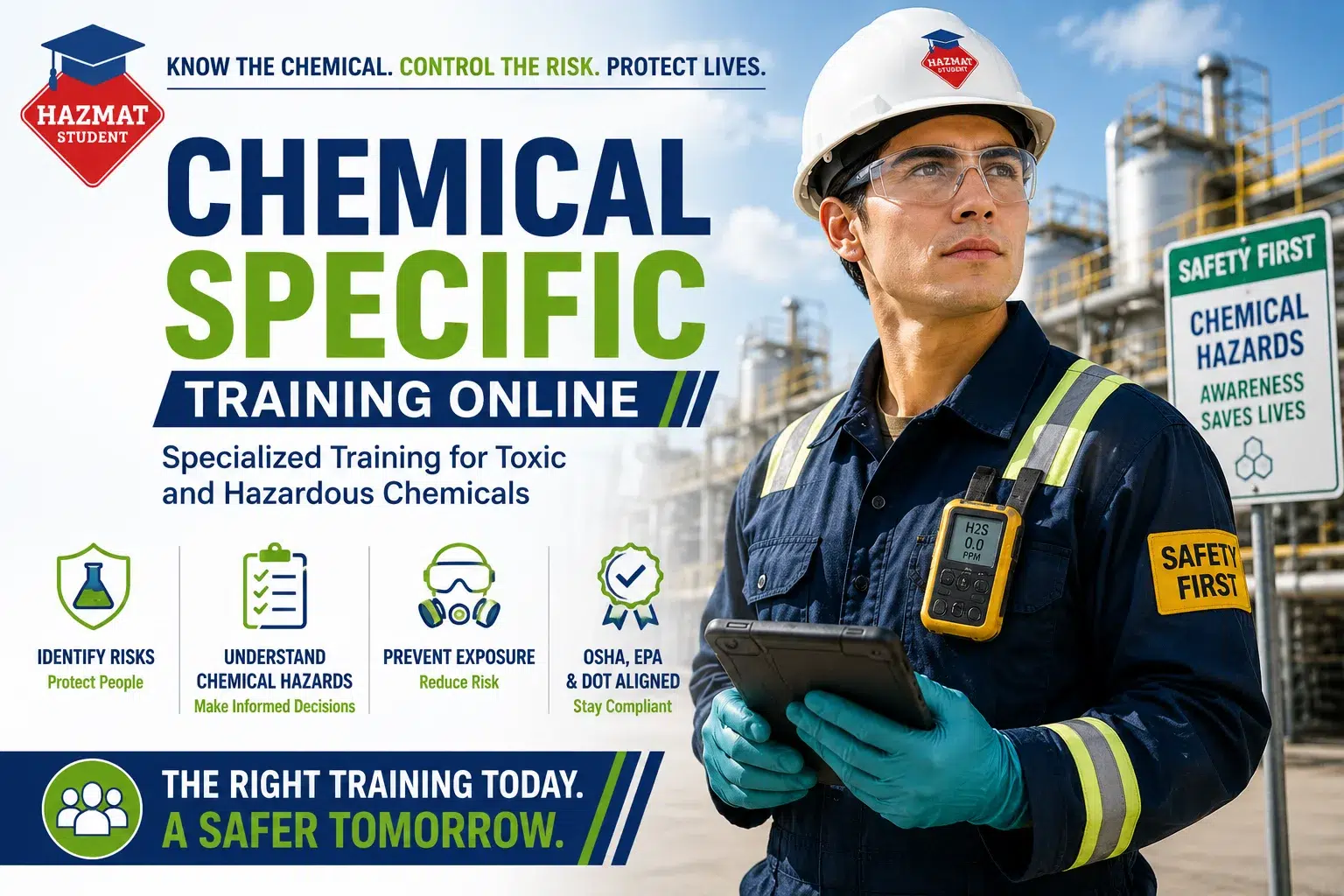
Chemical-Specific Training Online
OSHA-aligned awareness training across 16 courses under 29 CFR 1910 Subpart Z & 29 CFR 1926. Self-paced, instant certificate, accepted nationwide.
What Is Chemical-Specific Training?
Chemical-specific training is OSHA-required awareness training for workers who may be exposed to a particular hazardous substance regulated under 29 CFR 1910 Subpart Z — Toxic and Hazardous Substances and parallel construction standards in 29 CFR 1926. Each regulated chemical has its own training requirements covering health effects, permissible exposure limits, medical surveillance, PPE selection, and emergency procedures. Awareness-level courses start at $19.95 at HazMat Student.
The Federal Regulatory Framework
Substance-specific training is mandated under 29 CFR 1910 Subpart Z (general industry) and parallel sections in 29 CFR 1926 (construction). EPA standards apply to asbestos work under TSCA. DOT applies to hazmat transportation. NIOSH publishes recommended exposure limits (RELs) that often complement OSHA's permissible exposure limits (PELs). Employers remain responsible for site-specific training and hands-on components beyond online awareness instruction.
What Awareness Training Covers
- Chemical health effects and routes of exposure
- OSHA permissible exposure limits (PELs) and action levels
- Recognizing signs of overexposure
- PPE selection and respiratory protection basics
- Medical surveillance triggers and worker rights
- Emergency procedures and spill response
Who This Training Is For
- Workers exposed to a regulated chemical at or above the action level
- New hires entering jobs with potential chemical exposure
- Workers needing annual refresher under their substance standard
- Safety managers documenting workforce compliance
- Contractors satisfying client training requirements
- Employees onboarding to a new chemical hazard
Related Training Paths
- Site cleanup or emergency response? Add 40-Hour HAZWOPER
- Need general chemical safety too? Pair with HazCom under 1910.1200
- Asbestos abatement crews (Class I-IV) can step up to worker-level training
- Shipping or transporting hazmat? See DOT Hazmat certification
16 Chemical-Specific Awareness Courses
Click any chemical to view the full course details, OSHA standard reference, syllabus, and pricing options. Most awareness courses are $19.95 with an optional Wallet ID Card upgrade. H2S has multiple tiers (2-hour, 4-hour OSHA/ANSI, 6-hour Certification).
H2S (Hydrogen Sulfide) Awareness
Critical for oil & gas, petrochemical, wastewater, and confined-space workers. Choose 2-hour OSHA, 4-hour OSHA/ANSI, or 6-hour OSHA/ANSI Certification. Wallet ID Card optional.
Asbestos Awareness
Required for workers in buildings where asbestos-containing materials may be present. Covers identification, health effects, and protective measures. EPA AHERA-aligned.
Benzene Awareness
For workers in refineries, chemical plants, and operations with potential benzene exposure. Covers GI and Construction. Carcinogen — strict exposure limits apply.
Silica (Respirable Crystalline) Awareness
Required for construction workers cutting, grinding, or drilling concrete, masonry, stone. Covers Table 1 specified exposure controls and competent person requirements.
Lead Awareness
For workers in painting, demolition, battery manufacturing, soldering, and lead-based operations. Covers blood lead monitoring, medical removal, and protective work practices.
Cadmium Awareness — General Industry
For general industry workers in electroplating, battery production, welding, brazing, and metal recycling. Covers exposure limits, monitoring, and medical surveillance.
Cadmium Awareness — Construction
For construction trades — welding, cutting, abrasive blasting, and demolition involving cadmium-coated or cadmium-containing materials.
Hexavalent Chromium Awareness
For workers in welding stainless steel, chrome plating, painting operations, and chromate-based industries. Strong carcinogen — exposure monitoring required.
Formaldehyde Awareness
For healthcare, pathology, embalming, manufacturing, and laboratory workers. Covers identification, exposure monitoring, and the carcinogen designation requirements.
Methylene Chloride Awareness
For workers exposed during paint stripping, vapor degreasing, foam manufacturing, and pharmaceutical production. EPA has tightened restrictions on this chemical.
Ethylene Oxide Awareness
For workers in medical device sterilization, healthcare, and chemical manufacturing. Highly reactive carcinogen with strict short-term exposure limits.
Vinyl Chloride Awareness
For PVC manufacturing, plastics production, and chemical industry workers. Known human carcinogen — one of OSHA's earliest substance-specific standards.
Inorganic Arsenic Awareness
For workers in smelting, glass manufacturing, electronics, pesticide production, and wood treatment. Covers both General Industry and Construction applications.
Acrylonitrile Awareness
For workers in plastics, synthetic rubber, acrylic fiber, and resin manufacturing. Listed carcinogen — exposure monitoring and medical surveillance required.
1,3-Butadiene Awareness
For synthetic rubber, plastics, and petrochemical workers. Used in tire manufacturing, latex production, and chemical intermediates. Known carcinogen.
Cotton Dust Awareness
For textile workers in yarn and fabric manufacturing, cotton ginning, and waste processing. Covers byssinosis prevention, exposure limits, and required monitoring.
Who Needs Chemical-Specific Awareness Training?
Substance-specific training requirements cross nearly every industry that handles, processes, transports, or generates regulated chemicals. Here is where these courses are most commonly required.
⚙ Oil, Gas & Petrochemical
- H2S awareness for well sites, refineries, midstream
- Benzene for refinery operators and tank crews
- 1,3-Butadiene for synthetic rubber and chemical plants
- Vinyl Chloride for PVC manufacturing facilities
🏗 Construction & Trades
- Silica for concrete, masonry, stone, drilling
- Asbestos for renovation, demolition, abatement support
- Lead for painting, demolition, soldering
- Cadmium for welding, brazing, electroplating
🏭 Manufacturing & Industrial
- Hexavalent Chromium for welding stainless, chrome plating
- Formaldehyde for resin, textile, particleboard
- Acrylonitrile for plastics and synthetic fibers
- Arsenic for smelting, glass, electronics
⚕️ Healthcare & Lab
- Ethylene Oxide for medical device sterilization
- Formaldehyde for pathology, embalming, anatomy labs
- Methylene Chloride for pharmaceutical manufacturing
- Asbestos for healthcare facility maintenance
🛒 Environmental & Remediation
- Asbestos for environmental consulting and abatement
- Lead for paint remediation and site cleanup
- Silica for demolition and excavation projects
- Arsenic for wood-treatment site work and remediation
🚑 Emergency & Public Safety
- H2S for wastewater treatment and confined-space response
- Vinyl Chloride for derailment and tank-fire response
- Methylene Chloride for industrial spill response
- Cross-trained HAZWOPER companion courses
How to Choose and Complete the Right Chemical Course
-
Identify the regulated chemical
Review the workplace SDS, exposure assessment, or job hazard analysis. Determine which OSHA-regulated chemical the worker is exposed to at or above the action level. Each of our chemical course pages lists the specific OSHA standard that triggers training.
-
Select the right course version
Some chemicals have multiple versions. H2S offers 2-hour OSHA, 4-hour OSHA/ANSI, and 6-hour OSHA/ANSI Certification tiers — pick based on employer or industry requirements. Cadmium has separate General Industry and Construction versions. Click into the chemical's page for full options.
-
Decide on the Wallet ID Card option
Most chemicals offer a Wallet ID Card add-on for $5 ($24.95 total). Required by some employers for field access; optional for most. The standard digital certificate is included free with the base course. You choose at enrollment.
-
Enroll at HazMat Student
Click Enroll Now from the chemical's page. After logging in at the OTS portal, click Signup for Course, search for the course, and click Select. Corporate accounts available for multi-worker enrollments.
-
Complete the self-paced online modules
Most awareness courses are 1-2 hours and can be completed in a single session. Log in and out as needed — progress saves automatically. Mobile-ready on any device.
-
Pass the exam and download your certificate
Complete the final exam. When you pass, your digital certificate and printable transcript are immediately available in your student account. Wallet ID Cards (if ordered) ship separately by mail.
When Chemical-Specific Training Makes the Difference
Substance-specific training is not paperwork. It directly governs whether a worker is qualified to enter a work area, handle a material, or respond to an exposure event. Four scenarios from the field.
🎯 Scenario 1 — The Contractor Crew at the Refinery Gate
A construction subcontractor arrives Monday morning at a Gulf Coast refinery for a 6-week tank cleaning project. The refinery safety officer pulls training records before site entry. Workers have HAZWOPER and HazCom, but no H2S awareness or Benzene awareness — both required for this site.
What's at Stake — Missing Chemical-Specific Training Is Expensive
OSHA's substance-specific standards in Subpart Z carry some of the steepest enforcement consequences in the entire 29 CFR. Untrained workers exposed to regulated chemicals create automatic citations, and the penalty math compounds quickly when multiple workers and multiple chemicals are involved.
OSHA's FY 2026 maximum penalty for a serious substance-specific training violation — assessed per worker, per chemical, per inspection. Adjusted annually for inflation.
Willful or repeat violations multiply penalties up to $165,514 each. Knowing about exposure and not training the workforce is exactly what willful citations look like.
A single worker exposed to three regulated chemicals without training = three separate citations. Multi-chemical worksites multiply the exposure fast.
Inspectors and client safety officers can halt operations until chemical-specific training records are produced — devastating for fixed-price contracts and tight schedules.
Source: OSHA Penalties (osha.gov) and DOL/OSHA news release of January 14, 2025. Penalty maximums adjusted annually under the Federal Civil Penalties Inflation Adjustment Act Improvements Act of 2015. Current maximums took effect January 15, 2025 and carry forward into FY 2026.
The math employers underestimate
One worker × three regulated chemicals × no documented training = three citations at $16,550 each. That's $49,650 of exposure for a worker who could have completed all three awareness courses for $60 total. The ROI on chemical-specific training is not close.
6 Common Chemical-Specific Training Mistakes
After nearly two decades training workers across every Subpart Z chemical, these are the failure patterns we see most often — and the simple fix for each.
Why Safety Managers Choose HazMat Student for Chemical-Specific Training
HazMat Student has delivered online chemical awareness training since July 2007. Safety managers return year after year for the breadth of catalog, the price, and the reliability of the certificate.
Honest awareness-level scope
These are awareness courses — not abatement, not worker-level handling, not competent-person. We say so plainly on every page and in every course description. Workers and employers know exactly what the certificate covers, and what it does not. That clarity protects everyone.
Training a Mixed-Exposure Workforce?
Safety managers use HazMat Student to enroll workers across multiple chemical courses through a single corporate account — one invoice, one dashboard, one training record per worker. Especially efficient for crews with H2S + Benzene, or Asbestos + Lead + Silica multi-chemical exposure.
Call us: 1-888-342-9628
Frequently Asked Questions — Chemical-Specific Training
Chemical-specific training is OSHA-required awareness training for workers exposed to particular hazardous substances regulated under 29 CFR 1910 Subpart Z and parallel construction standards in 29 CFR 1926. Each substance has its own training requirements covering health effects, exposure limits, medical surveillance, PPE, and emergency procedures. This is separate from general HazCom training under 1910.1200.
Any worker potentially exposed to one of the substances regulated under OSHA's substance-specific standards. This includes workers in construction, manufacturing, oil and gas, healthcare, laboratories, environmental remediation, and any industry where exposure to chemicals like asbestos, benzene, silica, lead, or H2S is possible at or above the action level.
HazCom training under 29 CFR 1910.1200 covers general chemical hazard communication including SDS, labels, and the GHS system. Chemical-specific training under Subpart Z covers the detailed health effects, exposure limits, medical surveillance, and protective measures required for one specific substance. Workers exposed to a regulated substance typically need both.
Most chemical-specific awareness courses at HazMat Student start at $19.95 for online, self-paced training with instant digital certificate. The Wallet ID Card option adds $5 ($24.95 total). H2S has multiple tiers from $19.95 (2-hour OSHA) to $39.95 (6-hour OSHA/ANSI Certification). Volume pricing and corporate accounts available for multi-worker enrollments.
OSHA does not certify or endorse specific training providers, but allows online and computer-based training to satisfy the knowledge instruction component of substance-specific awareness requirements. Employers remain responsible for site-specific training, hands-on components, and ensuring training is effective. HazMat Student courses are designed to align with OSHA Subpart Z standards and are accepted by employers nationwide.
Most awareness courses are 1-2 hours and can be completed in a single session. H2S has 2-hour OSHA, 4-hour OSHA/ANSI, and 6-hour OSHA/ANSI Certification tiers. Self-paced format means workers log in and out as needed — progress is saved automatically.
OSHA can cite employers up to $16,550 per violation per worker for serious training violations under Subpart Z substance-specific standards (FY 2026 figures, adjusted annually). Willful violations multiply that figure up to $165,514 per violation. Penalties stack across chemicals — a worker exposed to three untrained substances generates three separate citations. Current penalty schedule: osha.gov/penalties.
Most OSHA substance-specific standards require initial training and then refresher or update training at least annually, or whenever workplace conditions change in ways that affect exposure. Specific frequencies vary by standard — for example, 1910.1001 (Asbestos) requires annual training, as does 1910.1028 (Benzene). Always check the specific standard for the chemical in question.
Yes. HazMat Student's corporate account system supports group enrollment across multiple chemical courses, volume pricing, consolidated invoicing and completion tracking dashboards for safety managers. Especially efficient for crews needing multi-chemical training (e.g., H2S + Benzene for refinery work, or Asbestos + Lead + Silica for remediation work). Call 1-888-342-9628 or set up your account online.
Yes. Most chemical-specific awareness courses have a Wallet ID Card option that adds a physical PVC card with photo and certification details for an additional $5 ($24.95 total). The standard digital certificate is included in the base course price. Required by some employers for field access; optional for most. You choose at enrollment.
All Chemical Courses & Related Resources
Find Your Chemical-Specific Training Today
Trusted by safety managers and workers nationwide since July 2007.
Browse 16 OSHA-aligned chemical awareness courses from $19.95 — 100% online, self-paced, instant certificate. Corporate accounts available for multi-chemical mixed-exposure workforces.

