
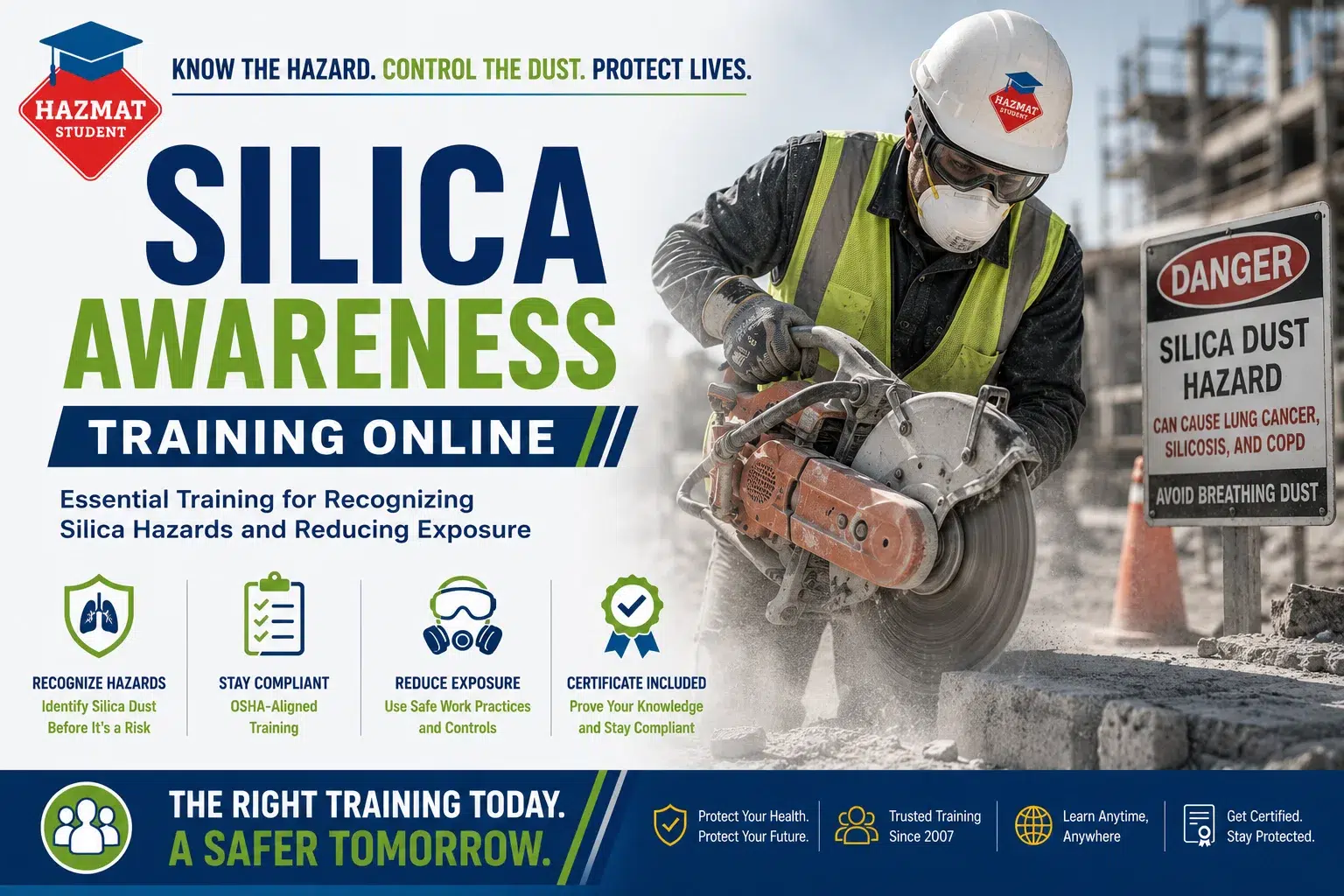
Silica Awareness Training Online
OSHA-aligned respirable crystalline silica training built around 29 CFR 1926.1153 (Construction) and 29 CFR 1910.1053 (General Industry). Covers the 50 μg/m³ PEL, Table 1 controls, and silicosis prevention. Self-paced, instant certificate.
What Is Silica Awareness Training?
Silica awareness training teaches workers how to recognize respirable crystalline silica hazards — the dust generated by cutting, grinding, drilling, or sandblasting concrete, masonry, stone, brick, mortar, and other silica-containing materials. The training covers OSHA's 50 μg/m³ PEL, the Table 1 specified controls, the health effects (silicosis, lung cancer, COPD, kidney disease), and safe work practices. Required under 29 CFR 1926.1153 for construction and 29 CFR 1910.1053 for general industry. HazMat Student's awareness course is $19.95 with an optional Wallet ID Card for $24.95.
The Federal Regulatory Framework for Silica
OSHA enforces silica exposure under two parallel standards: 29 CFR 1926.1153 for construction and 29 CFR 1910.1053 for general industry and maritime. Both standards became effective June 23, 2016 under the OSHA Final Rule on Occupational Exposure to Respirable Crystalline Silica, which lowered the construction PEL by 80% from the previous standard. The PEL is 50 μg/m³ as an 8-hour TWA, with an action level of 25 μg/m³ that triggers exposure assessment, medical surveillance, and training requirements.
What This Course Covers
- Respirable crystalline silica properties and sources
- Tasks that generate silica dust exposure
- OSHA PEL, action level, and Table 1 controls
- Health effects: silicosis, lung cancer, COPD, kidney
- Engineering controls and work practice methods
- Respiratory protection and PPE selection
Who Needs This Training
- Concrete cutters, grinders, and finishers
- Masons, bricklayers, and stone workers
- Demolition and renovation contractors
- Sandblasters and abrasive blasters
- Drillers, jackhammer operators, dust-generating tool users
- Foundry and stone fabrication workers
What This Is NOT For
- Competent Person designation under 1926.1153(g)(4)
- Industrial hygienist certification
- OSHA 10/30 construction safety training
- HAZWOPER site work — see our 40-Hour HAZWOPER
Silica Awareness Training — Two Options
The base course includes the instant digital certificate. The Wallet ID Card option adds a physical PVC card with your name, photo, and certification details for $5 more — required by some employers for jobsite verification. Both options deliver identical course content.
Silica Awareness for Construction Online
- OSHA 29 CFR 1926.1153 & 1910.1053 content
- 50 μg/m³ PEL & 25 μg/m³ action level
- Table 1 specified controls explained
- Silicosis, lung cancer, COPD health effects
- Engineering controls and work practices
- Respiratory protection basics
- Digital certificate (printable)
- Mobile-ready on any device
- Permanent record at OTS student portal
Silica Awareness + Wallet ID Card
- Everything in Standard option
- Physical PVC Wallet ID Card
- Card includes name, photo, dates
- Required by some GCs for jobsite access
- Preferred for multi-site contractor work
- Ships separately by mail after course completion
- Digital certificate still included free
- Adds only $5 to base course price
OSHA Silica Exposure Limits — What You'll Learn
Every silica course at HazMat Student teaches the federal exposure limits set by OSHA's 2016 Final Rule. Silica dust is invisible at the particle size that causes disease — workers cannot see it, smell it, or feel it. The only protection is knowing the limits and following the controls.
Source: OSHA Silica Topic Page (osha.gov), Final Rule Federal Register (March 25, 2016), and OSHA Construction Silica Info. Effective date June 23, 2016. Both standards apply across all covered industries.
The "invisible dust" problem
Respirable crystalline silica particles are 10 micrometers and smaller — invisible to the naked eye. Workers cutting concrete, grinding mortar, or drilling masonry generate this dust without seeing what's actually airborne. The visible cloud at a concrete saw is only the largest particles; the dangerous fraction is the invisible one that bypasses every natural defense in the respiratory tract and lodges deep in the lungs.
Where Silica Awareness Training Is Required
Respirable crystalline silica exposure is regulated across every industry that cuts, grinds, drills, or fractures silica-containing materials. Construction is the largest sector, but general industry and maritime have parallel requirements under 1910.1053.
🏗 Concrete & Masonry
- Concrete cutters and grinders
- Brick and block masons
- Tuckpointers and mortar workers
- Concrete drilling and core sampling
🔨 Stone & Tile
- Engineered stone fabricators (countertops)
- Natural stone cutting and polishing
- Tile setters and stone installers
- Quarry operations and stone yards
🚧 Demolition & Renovation
- Building demolition crews
- Concrete chipping and scaling
- Site cleanup and debris handling
- Renovation prep workers
⚙ Foundry & Industrial
- Foundry sand handling and casting
- Refractory work and brick lining
- Industrial sandblasting operations
- Ceramic and glass manufacturing
🚝 Highway & Underground
- Road and highway concrete work
- Tunneling and underground mining
- Hydraulic fracturing sand handling
- Pipeline trenching in rocky soil
🛡 Specialty Trades
- Drywall finishers and joint compound sanders
- Painters using silica-containing primers
- Roofers handling shingles and tiles
- HVAC installers cutting concrete chases
How to Enroll and Complete Silica Awareness Training
-
Confirm awareness is the right level
Verify with your employer that awareness training matches your role. Awareness covers workers exposed to silica dust. Workers serving as Competent Person under 1926.1153(g)(4) may need additional higher-tier training. When in doubt, call us at 1-888-342-9628.
-
Decide on the Wallet ID Card
Add the optional Wallet ID Card for $5 more ($24.95 total) if required by your general contractor or preferred for jobsite verification. The standard digital certificate is included free with the base course.
-
Enroll online
Click Enroll Now from the pricing section above. Create your student account at the OTS portal, then click Signup for Course and select the course you need. Corporate accounts available for crews.
-
Complete the self-paced modules
Log in from any device. The course is self-paced — log in and out as needed, progress saves automatically. Most workers complete the course in a single session of about 2 hours.
-
Pass the exam and download your certificate
Complete the final exam. When you pass, your digital certificate and printable transcript are immediately available in your student account. Wallet ID Cards (if ordered) ship separately by mail.
-
Calendar your annual refresher
While OSHA does not specify a fixed annual interval, most general contractors and pre-qualification systems (ISN, Avetta, PEC Premier) enforce annual silica refresher. Calendar the renewal date 60 days before expiration.
When Silica Training Pays Off — 4 Scenarios
Silica training is not paperwork. It governs whether a worker can step onto a concrete jobsite, operate a dust-generating tool, or pass an OSHA inspection without exposing themselves and their employer to citation. Four scenarios from the field.
🏗 Scenario 1 — The Concrete Cutting Citation
A general contractor on a residential demolition site has workers cutting concrete slabs with handheld saws. No water suppression, no shrouded saw, no respirators. An OSHA compliance officer responds to a neighbor's complaint about dust. The CO finds 5 workers with no documented silica awareness training and no exposure assessment on file.
What's at Stake — Missing Silica Training Is Expensive
Silica is one of OSHA's most-cited construction standards. The 2016 Final Rule created detailed, enforceable provisions for exposure assessment, engineering controls, written exposure control plans, and worker training — each one a potential citation. Stop-work orders are common when silica violations are observed.
OSHA's FY 2026 maximum penalty for a serious silica training violation — assessed per untrained worker, per inspection. Adjusted annually for inflation.
Willful or repeat violations multiply penalties up to $165,514 each. Knowing workers are cutting concrete without training is exactly what willful citations look like.
OSHA inspectors and GC safety officers routinely halt dust-generating work until training and exposure control plans are documented. Single-day shutdowns on tight schedules are devastating.
Silica citations stack: training, exposure assessment, controls, written plan, respiratory protection, medical surveillance, recordkeeping. One inspection can trigger 6+ separate citations per worker.
Source: OSHA Penalties (osha.gov) and DOL/OSHA news release of January 14, 2025. Penalty maximums adjusted annually under the Federal Civil Penalties Inflation Adjustment Act Improvements Act of 2015.
Silica is OSHA's construction enforcement priority
Since the 2016 Final Rule took effect, silica has consistently ranked in OSHA's top-cited construction standards. The agency runs regular national emphasis programs targeting silica exposure on jobsites. The dust is visible to inspectors driving past. The documentation gaps are easy to verify. The risk is real: a crew of 10 untrained workers on one citation = $165,500 of exposure. The same crew trained in advance = $199.50 total prevention cost.
6 Common Silica Training Mistakes
After nearly two decades training silica workers and employers, these are the failure patterns we see most often — and the simple fix for each.
Why Construction Safety Managers Choose HazMat Student for Silica
HazMat Student has delivered online silica training since the 2016 OSHA Final Rule first took effect — and continuously online safety training since July 2007. Construction safety managers, concrete contractors, and stone fabrication shops return year after year for the price, the speed, and the reliability of the certificate.
Honest awareness-level scope
We say plainly that this is an awareness course — not Competent Person training, not industrial hygiene certification, not OSHA 30. Workers and employers know exactly what the certificate covers, and what it does not. That clarity protects everyone at audit time and during pre-qualification reviews.
Training a Concrete or Masonry Crew?
Safety managers use HazMat Student to enroll concrete cutters, masons, stone fabricators, and demolition crews in silica awareness through a single corporate account — one invoice, one dashboard, one training record per worker. Pairs naturally with our Asbestos and Lead courses for full construction chemical training stacks.
Call us: 1-888-342-9628
Frequently Asked Questions — Silica Awareness Training
Silica awareness training teaches workers how to recognize respirable crystalline silica hazards, understand the health risks (silicosis, lung cancer, COPD, kidney disease), and follow safe work practices including the Table 1 specified controls. Required under 29 CFR 1926.1153 for construction workers and 29 CFR 1910.1053 for general industry and maritime workers exposed at or above the action level of 25 μg/m³.
Workers who perform tasks that generate respirable crystalline silica dust, including concrete cutting, masonry work, stone fabrication, sandblasting, drilling, jackhammering, mixing, grinding, demolition, foundry work, and any operation involving silica-containing materials. Both construction (1926.1153) and general industry (1910.1053) standards trigger training requirements.
OSHA's permissible exposure limit for respirable crystalline silica is 50 micrograms per cubic meter of air (50 μg/m³) as an 8-hour time-weighted average, with an action level of 25 μg/m³ under 29 CFR 1926.1153(c) and 29 CFR 1910.1053(c). The action level triggers exposure assessment, medical surveillance, and training requirements. The PEL was lowered 80% from the previous construction standard when OSHA's silica rule took effect in 2016.
Table 1 in 29 CFR 1926.1153(c) lists 18 specific construction tasks and equipment (handheld masonry saws, walk-behind saws, drivable saws, jackhammers, rotary hammers, dust-generating tools) along with required engineering and work practice controls and respiratory protection requirements. Employers who fully implement Table 1 controls for a listed task are not required to perform exposure assessment for that task under 1926.1153(d).
Silica awareness training at HazMat Student is $19.95 for online, self-paced training with instant digital certificate. The Wallet ID Card option adds $5 ($24.95 total). Corporate accounts are available for multi-worker enrollments with volume pricing and consolidated invoicing — especially efficient for construction crews where every worker needs the training.
The Silica Awareness course averages about 2 hours. The course is self-paced — you can log in and out as needed, progress saves automatically. Most workers finish in a single session.
OSHA requires training under 29 CFR 1926.1153(i) and 29 CFR 1910.1053(j) when a worker is first assigned to silica-exposed work and whenever workplace conditions change. While neither standard mandates a specific annual interval, most employers and contractor pre-qualification systems (ISN, Avetta, PEC Premier) enforce annual refresher to ensure current knowledge. Calendar the renewal 60 days before due.
OSHA can cite employers up to $16,550 per violation per worker for serious training violations (FY 2026 figures, adjusted annually). Willful or repeat violations multiply that figure up to $165,514 per violation. Silica is one of OSHA's most-cited construction standards because the 2016 rule is detailed, the dust is visible, and the documentation is straightforward for inspectors to verify. Current penalty schedule: osha.gov/penalties.
Respirable crystalline silica exposure causes silicosis (a progressive, irreversible, and fatal lung disease), lung cancer (silica is a Group 1 IARC carcinogen), chronic obstructive pulmonary disease (COPD), and kidney disease. Acute silicosis can develop within weeks of high exposure (a documented risk in engineered stone fabrication); chronic silicosis develops over 10-30 years of lower-level exposure. There is no cure — only prevention through exposure control and proper training.
HazMat Student's silica awareness certificate is accepted by construction contractors, general contractors, and contractor pre-qualification systems (ISN, Avetta, PEC Premier) nationwide. The certificate is suitable for OSHA recordkeeping and pre-employment training verification. Always confirm with your specific employer or site safety officer for any additional site-specific requirements.
Related Courses & Authoritative Silica Resources
Get Silica Awareness Certified Today
Trusted by concrete, masonry, stone, and construction safety managers since July 2007.
Enroll for $19.95 — 100% online, self-paced, instant certificate. Add the Wallet ID Card for $5 more if your GC needs it.

