
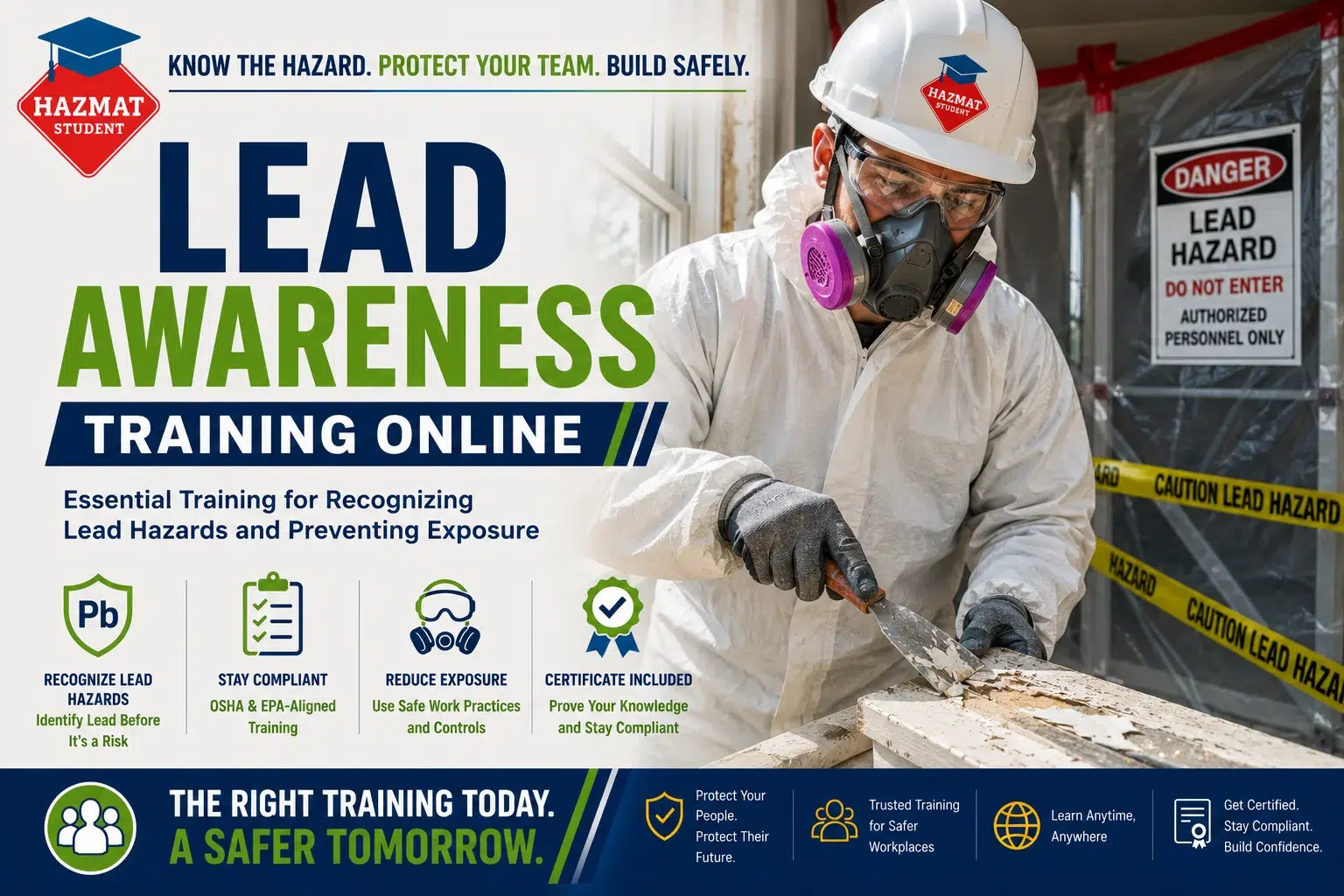
Lead Awareness Training Online
OSHA-aligned lead awareness training built around 29 CFR 1910.1025 (General Industry) and 29 CFR 1926.62 (Construction). Covers the 50 μg/m³ PEL, blood lead level monitoring, and Medical Removal Protection. Self-paced, instant certificate.
What Is Lead Awareness Training?
Lead awareness training teaches workers about the hazards of occupational lead exposure — a cumulative toxin that builds up in bones, blood, and organs over years of low-level contact. The training covers OSHA's 50 μg/m³ PEL, the 30 μg/m³ action level, blood lead level (BLL) monitoring, Medical Removal Protection, and safe work practices. Required under 29 CFR 1910.1025 for general industry and 29 CFR 1926.62 for construction. HazMat Student's awareness course is $19.95 with an optional Wallet ID Card for $24.95.
The Federal Regulatory Framework for Lead
OSHA enforces lead exposure under two parallel standards: 29 CFR 1910.1025 for general industry and 29 CFR 1926.62 for construction. Both set a PEL of 50 μg/m³ as an 8-hour TWA and an action level of 30 μg/m³ that triggers exposure monitoring, medical surveillance, and training. EPA's Renovation, Repair, and Painting (RRP) Rule under 40 CFR Part 745 adds federal requirements for lead-based paint work in pre-1978 housing and child-occupied facilities.
What This Course Covers
- Lead chemistry, sources, and routes of exposure
- Acute and chronic health effects of lead
- OSHA PEL, action level, and worker protections
- Blood Lead Level (BLL) monitoring and targets
- Medical Removal Protection (MRP) program
- Engineering controls, work practices, and PPE
Who Needs This Training
- Painting and lead-based paint workers
- Demolition and renovation crews
- Battery manufacturing and recycling
- Soldering, brazing, and metal work
- Smelting and foundry operations
- Firing range maintenance and lead salvage
What This Is NOT For
- EPA RRP Certified Renovator certification
- Lead abatement contractor (state-licensed) training
- Competent Person designation under 1926.62(d)(2)(iii)
- HAZWOPER site work — see our 40-Hour HAZWOPER
Lead Awareness Training — Two Options
The base course includes the instant digital certificate. The Wallet ID Card option adds a physical PVC card with your name, photo, and certification details for $5 more — required by some employers for jobsite verification. Both options deliver identical course content.
Lead Awareness for General Industry Online
- OSHA 29 CFR 1910.1025 & 1926.62 content
- 50 μg/m³ PEL & 30 μg/m³ action level
- Blood Lead Level monitoring explained
- Medical Removal Protection (MRP) program
- Engineering controls & work practices
- Respiratory protection basics
- Digital certificate (printable)
- Mobile-ready on any device
- Permanent record at OTS student portal
Lead Awareness + Wallet ID Card
- Everything in Standard option
- Physical PVC Wallet ID Card
- Card includes name, photo, dates
- Required by some employers for jobsite access
- Preferred for multi-site contractor work
- Ships separately by mail after course completion
- Digital certificate still included free
- Adds only $5 to base course price
OSHA Lead Exposure Limits & Blood Lead Targets
Every lead course at HazMat Student teaches both the airborne exposure limits and the blood lead level (BLL) targets that protect worker health. Lead is a cumulative toxin — what enters your body today stays in your bones for decades. Knowing the numbers is the foundation of every protective measure that follows.
Source: OSHA Lead Topic Page (osha.gov), 29 CFR 1910.1025 Appendix A, and 29 CFR 1926.62 Appendix A. If exposed more than 8 hours per workday, the allowable TWA is reduced by formula (400 ÷ hours worked).
Medical Removal Protection — the lead standard's unique provision
When a worker's blood lead level reaches 50 μg/dL (confirmed by a follow-up test within two weeks), the OSHA lead standard requires the employer to remove that worker from lead-exposed work. The worker can return when BLL declines to 40 μg/dL. During removal, the employer must maintain the worker's pay, seniority, and benefits. No other OSHA standard has a comparable provision — and it creates a powerful incentive for employers to control exposure aggressively rather than reactively.
Where Lead Awareness Training Is Required
OSHA's lead standards cover approximately 120 occupations across construction and general industry where lead exposure occurs. Awareness training is required for any worker exposed at or above the 30 μg/m³ action level.
🎨 Painting & Coatings
- Lead-based paint removal in pre-1978 buildings
- Bridge and steel structure repainting
- Industrial coatings application and removal
- Surface preparation and sandblasting
🚧 Demolition & Renovation
- Building demolition in pre-1978 structures
- Window and door replacement work
- Renovation prep in older housing
- Salvage operations
🔋 Battery & Recycling
- Lead-acid battery manufacturing
- Battery recycling and breaking
- Secondary lead smelting operations
- Battery distribution and warehousing
🔧 Metal & Soldering
- Electronics soldering operations
- Stained glass and leaded glass work
- Plumbing solder removal and repair
- Lead pipe identification and remediation
🏭 Primary Industry
- Primary lead smelting operations
- Foundry operations using lead alloys
- Ammunition and bullet manufacturing
- Lead pigment and chemical production
🎯 Specialty & Other
- Firing range maintenance crews
- Radiator repair shops
- Auto body and refinishing operations
- Lead crystal and ceramics manufacturing
How to Enroll and Complete Lead Awareness Training
-
Confirm awareness is the right level
Verify with your employer that awareness training matches your role. Awareness covers workers exposed to lead at or above the action level. Workers performing direct lead abatement may need Competent Person training under 1926.62(d)(2)(iii). Lead-based paint workers in pre-1978 housing may need EPA RRP certification.
-
Decide on the Wallet ID Card
Add the optional Wallet ID Card for $5 more ($24.95 total) if required by your employer or preferred for jobsite verification. The standard digital certificate is included free with the base course.
-
Enroll online
Click Enroll Now from the pricing section above. Create your student account at the OTS portal, then click Signup for Course and select Lead Awareness for General Industry Online. Corporate accounts available for crews.
-
Complete the self-paced modules
Log in from any device. The course is self-paced — log in and out as needed, progress saves automatically. Most workers complete the course in a single session of about 2 hours.
-
Pass the exam and download your certificate
Complete the final exam. When you pass, your digital certificate and printable transcript are immediately available in your student account. Wallet ID Cards (if ordered) ship separately by mail.
-
Calendar your annual refresher
OSHA requires annual lead training refresher under 29 CFR 1910.1025(l) and 29 CFR 1926.62(l). Calendar the renewal date 60 days before expiration.
When Lead Training Pays Off — 4 Scenarios
Lead training is not paperwork. It governs whether a worker can recognize a lead exposure source, demand BLL monitoring, or escape a citation when an inspector arrives. Four scenarios from the field.
🎨 Scenario 1 — The Bridge Repainting Project
A regional painting contractor wins a contract to strip and repaint a 1956 highway bridge with original lead-based primer. Workers begin abrasive blasting without exposure monitoring, without BLL baseline tests, and without lead awareness training. Three weeks in, a project manager from a partner contractor notes the lack of containment and reports it to OSHA.
What's at Stake — Missing Lead Training Is Expensive
OSHA's lead standards are among the most aggressively enforced in 29 CFR. Citations stack across training, exposure assessment, medical surveillance, Medical Removal Protection, written compliance programs, and recordkeeping. Lead enforcement actions routinely exceed $100,000 because so many separate violations can occur in a single inspection.
OSHA's FY 2026 maximum penalty for a serious lead training violation — assessed per untrained worker, per inspection. Adjusted annually for inflation.
Willful or repeat violations multiply penalties up to $165,514 each. Knowing about lead exposure and not training the workforce is exactly what willful citations look like.
When BLL hits 50 μg/dL, removed workers must keep full pay, seniority, and benefits. Untrained exposure events trigger MRP cascades across crews.
Pre-1978 housing work triggers EPA RRP enforcement separate from OSHA. State lead programs add a third layer. State child blood lead reports can trigger OSHA referrals.
Source: OSHA Penalties (osha.gov) and DOL/OSHA news release of January 14, 2025. Penalty maximums adjusted annually under the Federal Civil Penalties Inflation Adjustment Act Improvements Act of 2015.
The lead penalty math that surprises employers
A single OSHA lead inspection can trigger separate citations across 6-8 categories: training, exposure assessment, monitoring, medical surveillance, Medical Removal Protection, written compliance program, respiratory protection, and recordkeeping. Each category is itself per-worker. Recent enforcement examples include a battery manufacturer cited for $160,727 in a single 2023 action. Crew of 10 untrained workers × multiple categories = quickly into six figures. Prevention cost for the same 10 workers: $199.50.
6 Common Lead Training Mistakes
After nearly two decades training lead-exposed workers and employers, these are the failure patterns we see most often — and the simple fix for each.
Why Painting, Demolition & Battery Industry Safety Managers Choose HazMat Student for Lead
HazMat Student has delivered online lead awareness training since July 2007. Painting contractors, demolition crews, battery manufacturers, and pre-1978 housing renovators return year after year for the price, the speed, and the reliability of the certificate.
Honest awareness-level scope
We say plainly that this is an awareness course — not Competent Person training, not EPA RRP certification, not lead abatement contractor licensing. Workers and employers know exactly what the certificate covers and what it does not. That clarity protects everyone at audit time.
Training a Lead-Exposed Crew?
Safety managers use HazMat Student to enroll painting, demolition, battery, and industrial crews in lead awareness through a single corporate account — one invoice, one dashboard, one training record per worker. Pairs naturally with our Asbestos and Silica courses for full pre-1980 building remediation training stacks.
Call us: 1-888-342-9628
Frequently Asked Questions — Lead Awareness Training
Lead awareness training teaches workers about the hazards of occupational lead exposure, the OSHA permissible exposure limit, blood lead level monitoring, medical removal protection, and safe work practices. Required under 29 CFR 1910.1025 for general industry workers and 29 CFR 1926.62 for construction workers exposed at or above the action level of 30 μg/m³.
Workers exposed to lead in painting, demolition, renovation, soldering, battery manufacturing, smelting, foundry operations, firing ranges, radiator repair, lead-based glass and ceramics work, salvage operations, and any task involving lead-containing materials. Both construction (1926.62) and general industry (1910.1025) standards trigger training requirements at exposures at or above the action level.
OSHA's permissible exposure limit for lead is 50 micrograms per cubic meter of air (50 μg/m³) as an 8-hour time-weighted average, with an action level of 30 μg/m³ under 29 CFR 1910.1025(c) and 29 CFR 1926.62(c). The action level triggers exposure monitoring, medical surveillance, and training requirements. If a worker is exposed for more than 8 hours per day, the allowable TWA is reduced using a formula (400 ÷ hours worked).
Medical Removal Protection (MRP) is a unique provision of the OSHA lead standard. A worker is removed from lead-exposed work when their blood lead level (BLL) reaches 50 μg/dL (confirmed by a follow-up test within two weeks). The worker can return to lead-exposed work when their BLL declines to 40 μg/dL. During removal, the employer must maintain the worker's pay, seniority, and benefits. This is a powerful incentive for employers to control exposure aggressively rather than reactively.
OSHA's health protection goal is for worker blood lead levels to be maintained at or below 40 μg/dL of whole blood under both 1910.1025 and 1926.62. For workers (male or female) who intend to have children, OSHA recommends maintaining BLL below 30 μg/dL to minimize adverse reproductive health effects. CDC and NIOSH advocate for even lower BLL targets reflecting current science on low-level lead toxicity.
Lead awareness training at HazMat Student is $19.95 for online, self-paced training with instant digital certificate. The Wallet ID Card option adds $5 ($24.95 total). Corporate accounts are available for multi-worker enrollments with consolidated billing — especially efficient for painting, demolition, and battery manufacturing crews where every worker needs the training.
The Lead Awareness course averages about 2 hours. The course is self-paced — you can log in and out as needed, progress saves automatically. Most workers finish in a single session.
OSHA requires lead training annually under 29 CFR 1910.1025(l)(1)(i) and 29 CFR 1926.62(l)(1) for workers exposed at or above the action level. Calendar the renewal date 60 days before expiration to avoid lapses. Workers who change job assignments or whose exposure conditions change must also be retrained.
OSHA can cite employers up to $16,550 per violation per worker for serious training violations (FY 2026 figures, adjusted annually). Willful or repeat violations multiply that figure up to $165,514 per violation. Lead is one of OSHA's most-cited general industry and construction standards because exposure documentation, BLL monitoring records, and training records are all directly verifiable during inspections. Current penalty schedule: osha.gov/penalties.
HazMat Student's lead awareness certificate is accepted by construction contractors, general industry employers, painting and demolition contractors, and contractor pre-qualification systems (ISN, Avetta, PEC Premier) nationwide. The certificate is suitable for OSHA recordkeeping and pre-employment training verification. Always confirm with your specific employer or site safety officer for any additional site-specific requirements.
Related Courses & Authoritative Lead Resources
Get Lead Awareness Certified Today
Trusted by painting, demolition, battery, and industrial safety managers since July 2007.
Enroll for $19.95 — 100% online, self-paced, instant certificate. Add the Wallet ID Card for $5 more if your employer needs it.

