
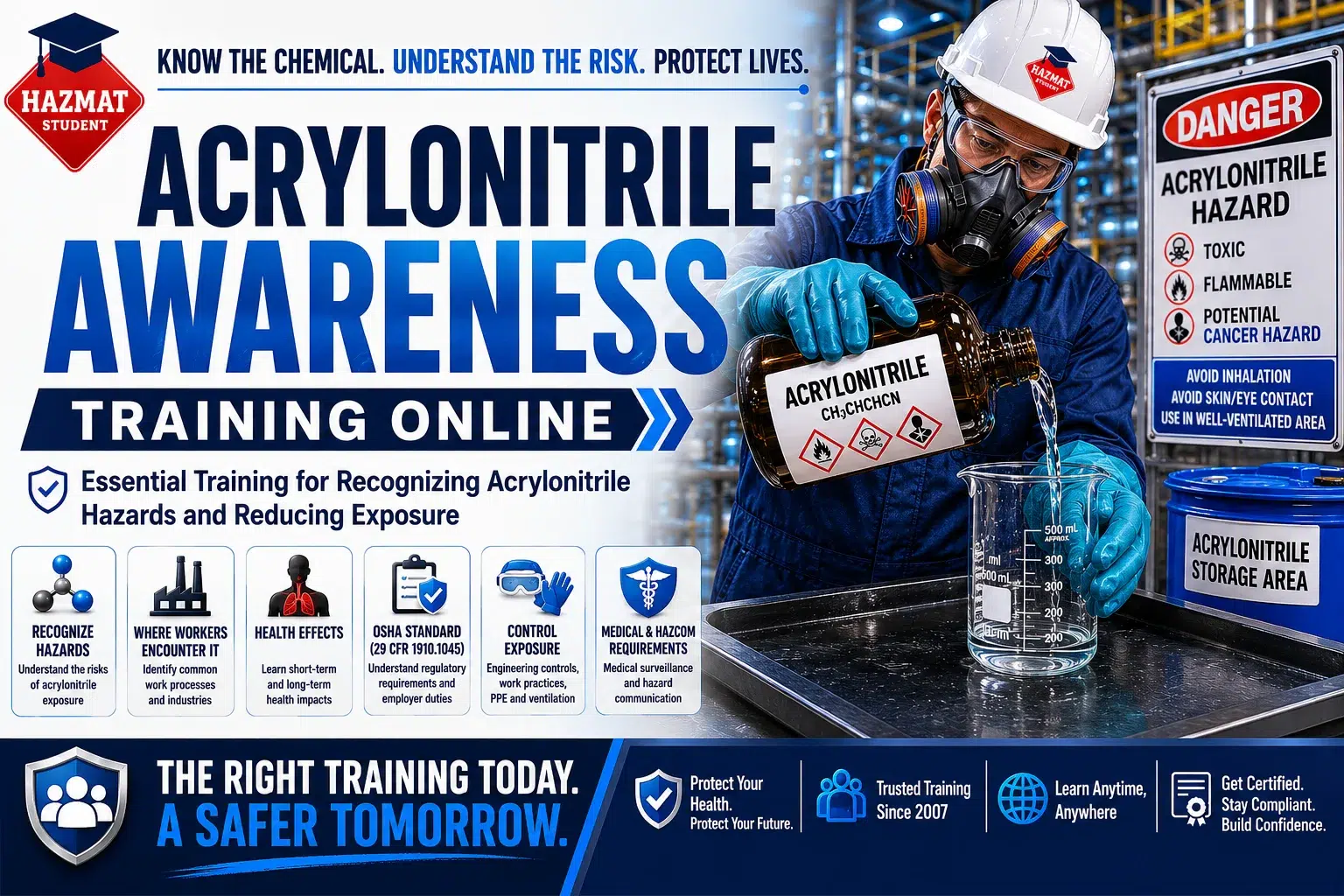
Acrylonitrile Awareness Training Online
Acrylonitrile awareness training built around 29 CFR 1910.1045 (General Industry), meeting the OSHA training requirements for workers exposed to acrylonitrile. Covers the 2 ppm PEL, 1 ppm action level, 10 ppm ceiling, and OSHA-required medical surveillance. Self-paced, instant certificate.
What Is Acrylonitrile Awareness Training?
Acrylonitrile awareness training teaches workers about the hazards of occupational acrylonitrile exposure — a probable human carcinogen whose acute toxicity resembles cyanide poisoning. The training covers OSHA's 2 ppm PEL, the 1 ppm action level, the 10 ppm ceiling, medical surveillance for employees exposed at or above the action level, and safe work practices. Required under 29 CFR 1910.1045 for general industry. HazMat Student's awareness course is $19.95.
The Federal Regulatory Framework for Acrylonitrile
OSHA enforces acrylonitrile exposure under 29 CFR 1910.1045 for general industry. OSHA sets a 2 ppm PEL, a 1 ppm action level, and a 10 ppm ceiling not to be exceeded in any 15-minute period. NIOSH publishes a more protective Recommended Exposure Limit (REL) of 1 ppm (TWA, Ca) in its Acrylonitrile Topic Page. NIOSH classifies acrylonitrile as a potential occupational carcinogen (Ca) and recommends a more protective 1 ppm REL.
What This Course Covers
- What acrylonitrile is and where it is used
- Where workers may encounter acrylonitrile on the job
- Health effects — from acute cyanide-like toxicity to cancer risk
- The PEL, action level, and 15-minute ceiling
- OSHA methods of compliance to prevent exposure
- Medical surveillance and hazard communication requirements
Who Needs This Training
- Acrylic fiber manufacturing operators
- Plastics and resin production workers
- Nitrile rubber and latex manufacturing crews
- Carbon fiber and aerospace composite workers
- Chemical plant operators and maintenance/turnaround crews
- Anyone exposed at or above the 1 ppm action level, or with potential skin/eye contact with liquid acrylonitrile
Related Training
Acrylonitrile Awareness Training
A single self-paced course with an instant printable certificate. Choose your option below and enroll in minutes.
- OSHA 29 CFR 1910.1045 content
- 2 ppm PEL, 1 ppm action level, 10 ppm ceiling
- 12 months of access
- Mobile-ready on any device
- Meets the annual training requirement
- Accepted by major operators & pre-qual systems
- Digital certificate (printable)
- Permanent record at OTS student portal
Acrylonitrile Exposure Limits at a Glance
All limits below are enforceable under 29 CFR 1910.1045(c). The action level — not the PEL — is what triggers the full set of monitoring, surveillance, and training obligations.
OSHA 29 CFR 1910.1045 and the NIOSH Pocket Guide to Chemical Hazards (acrylonitrile, CAS 107-13-1).
A dual hazard — cancer and cyanide-like acute toxicity
Acrylonitrile is unusual: it is a probable human carcinogen AND an acute poison whose mechanism resembles cyanide, capable of causing collapse and death from a single high exposure. Workers must be protected against both the long-term cancer risk and the immediate asphyxiant danger — which is why OSHA pairs a 2 ppm PEL with a hard 10 ppm 15-minute ceiling.
Industries Served
Acrylonitrile awareness training serves the industries that manufacture, handle, or process this monomer:
Acrylic Fiber Manufacturing
- Polymerization and spinning operations
- Monomer storage and transfer
- Line cleaning and maintenance
- Quality control sampling
Plastics & Resins
- ABS and SAN resin production
- Reactor and extrusion operations
- Compounding and pelletizing
- Bulk monomer handling
Nitrile Rubber & Latex
- Emulsion polymerization
- Latex compounding
- Reactor charging and cleanout
- Wastewater handling
Carbon Fiber & Aerospace
- Precursor (PAN) production
- Oxidation and carbonization lines
- Composite layup support
- Defense and aerospace supply
Chemical Manufacturing
- Propylene ammoxidation units
- Distillation and purification
- Tank farm and loading racks
- Turnaround and confined-space entry
Laboratory & QC
- Analytical sampling
- Method development
- Small-scale synthesis
- Sample storage and disposal
Course Content in Detail
Learning Objectives
After completing this course, learners will be able to:
- What acrylonitrile is and where it is used
- Where workers may encounter acrylonitrile on the job
- Health effects — from acute cyanide-like toxicity to cancer risk
- The PEL, action level, and 15-minute ceiling
- OSHA methods of compliance to prevent exposure
- Medical surveillance and hazard communication requirements
- Identify regulated areas and required protections
- Apply the action-level triggers for monitoring and surveillance
Course Modules
Defines acrylonitrile (vinyl cyanide), its industrial uses, and where workers encounter it.
You will learn to:
- Recognize acrylonitrile and its common names
- Identify industries and tasks with exposure
- Understand why it carries a substance-specific standard
- Locate acrylonitrile in your own workplace
Covers acute cyanide-like toxicity, cancer risk, and the OSHA PEL, action level, and ceiling.
You will learn to:
- Describe acute and chronic health effects
- State the 2 ppm PEL, 1 ppm action level, and 10 ppm ceiling
- Distinguish a ceiling from a STEL
- Explain inhalation and skin-contact routes
Methods of compliance, controls, regulated areas, and medical surveillance requirements.
You will learn to:
- Apply engineering and work-practice controls
- Understand regulated areas and PPE
- Describe medical surveillance triggers
- Know training frequency requirements
Engineering Controls and PPE for Acrylonitrile Exposure
OSHA's hierarchy of controls applies to acrylonitrile exposure: engineering controls first, work practice controls second, PPE last. The selections below match the requirements in 29 CFR 1910.1045(g).
Ventilation and Engineering Controls
Engineering controls are the first line of defense against acrylonitrile vapor.
- Closed-system transfer and sampling to prevent vapor release
- Local exhaust ventilation at emission and loading points
- Enclosure of high-emission process steps
- Routine leak detection and system-integrity checks
Respiratory Protection
Respiratory protection is used when engineering controls cannot keep exposures below the PEL.
- APR: Air-purifying respirators with organic-vapor cartridges where permitted by the exposure assessment
- SAR: Supplied-air respirators for higher or uncertain exposures
- SCBA: SCBA for emergency, IDLH, or unknown-concentration entries
- Respirator selection follows the employer's written respiratory protection program (29 CFR 1910.134)
Dermal Protection and Monitoring Instruments
Liquid acrylonitrile is hazardous on skin contact — dermal protection is required, not optional.
- Chemical-resistant gloves and suits rated for acrylonitrile — no skin contact with the liquid
- Eyewash and quick-drench stations where liquid contact is possible
- Photoionization detector (11.7 eV lamp) for field screening; NIOSH Method 1604 for compliance sampling
- Routine area and personal sampling against the 1 ppm action level
Acrylonitrile Medical Surveillance Program
Under 29 CFR 1910.1045(n), employers must provide a medical surveillance program to workers exposed to acrylonitrile. The program below summarizes the federal requirements that this course covers in depth.
Trigger and Schedule
Triggering threshold: Offered to employees exposed at or above the 1 ppm action level
Pre-placement exam: Medical and occupational history with emphasis on the skin, eyes, and respiratory and nervous systems
Periodic exam: Surveillance offered at initial assignment and periodically thereafter
Termination exam: Examination at termination of employment where indicated
Recordkeeping: Records retained for the duration of employment plus 30 years
Required Clinical Components
- Medical and occupational history with emphasis on the skin, eyes, and respiratory and nervous systems
- Physical exam for employees exposed at or above the action level
- Surveillance offered at initial assignment and periodically thereafter
- Physician's written opinion provided to the employer and employee
- Records retained for the duration of employment plus 30 years
Abnormality follow-up: Physician's written opinion provided to the employer and employee
How to Enroll in Acrylonitrile Awareness Training
-
Choose your option above
Choose the Acrylonitrile Awareness course at $19.95. Self-paced, fully online.
-
Enroll at the OTS portal
Click Enroll Now, log in to your student account, then click Signup for Course and search for "OSHA Acrylonitrile Awareness." Click Select to begin.
-
Complete and download your certificate
The course is self-paced. Pass the final exam and your digital certificate is immediately available in your OTS student account.
Real-World Acrylonitrile Training Scenarios
These composite scenarios show how acrylonitrile awareness training fits real compliance situations across the industries that handle it.
🧶 The Acrylic Fiber Line Restart
An acrylic fiber plant brings a polymerization line back online after maintenance and needs the crew current on acrylonitrile hazards before they handle monomer transfer.
What's at Stake — Missing Acrylonitrile Training Is Expensive
Under OSHA's current penalty schedule (effective January 15, 2025), employers can be cited up to $16,550 per serious violation per worker, with willful or repeat violations multiplied to $165,514. Acrylonitrile citations carry weight because recognized by employers and contractor pre-qualification systems nationwide — and carries its own substance-specific OSHA standard with exposure monitoring, regulated areas, and medical surveillance. For complete penalty details, recent enforcement examples, and the FY 2026 schedule from OSHA, see our OSHA Penalty Schedule reference and osha.gov/penalties.
Six Common Acrylonitrile Training Mistakes
The most common compliance gaps we see with acrylonitrile awareness:
1. Treating HazCom as a substitute
Assuming general Hazard Communication training covers acrylonitrile-specific requirements.
Fix: Acrylonitrile has its own standard (1910.1045) with a specific PEL, action level, ceiling, regulated areas, and medical surveillance — beyond generic HazCom.
2. Ignoring the skin-contact route
Focusing only on inhalation and overlooking that liquid acrylonitrile is dangerous on skin contact.
Fix: The standard specifically addresses potential skin or eye contact with liquid acrylonitrile; train on dermal protection, not just respiratory.
3. Confusing the ceiling with a STEL
Treating the 10 ppm limit as a 15-minute average that can be balanced out across the shift.
Fix: It is a ceiling — it must never be exceeded during any 15-minute period, even if the 8-hour average is fine.
4. Skipping the action-level triggers
Not realizing that reaching the 1 ppm action level triggers monitoring, medical surveillance, and training.
Fix: Track exposures against the 1 ppm action level and act on the triggers it sets in motion.
5. Letting training lapse
Treating the course as one-and-done.
Fix: Training is required at initial assignment and at least annually thereafter.
6. Underestimating acute toxicity
Viewing acrylonitrile only as a long-term cancer risk and not as an acute poison.
Fix: Acute exposure can cause cyanide-like collapse and death; emergency response must reflect that immediacy.
Trusted since July 2007 · 67,000+ courses completed · Instant certificate · Mobile-ready · Stored permanently in your OTS student account
Training Acrylonitrile-Exposed Crews?
Training a crew that handles acrylonitrile? Enroll your whole team through one corporate account — one dashboard, one record per worker, certificates recognized nationwide.
FAQs — Acrylonitrile Awareness Training
Helpful Links for Acrylonitrile Compliance Research
The federal and authoritative sources below are the primary references used to build and verify this page. Every figure cited on this page traces back to one of these links.
Glossary of Key Terms
Common regulatory and acrylonitrile-specific terms used in this course and in OSHA inspections. Click any term to expand the definition.
Training Is Cheaper Than the Citation.
Trusted since 2007 · 67,000+ courses completed
OSHA Acrylonitrile Awareness — $19.95. Self-paced, instant certificate, accepted by every major operator and contractor pre-qualification system.

