
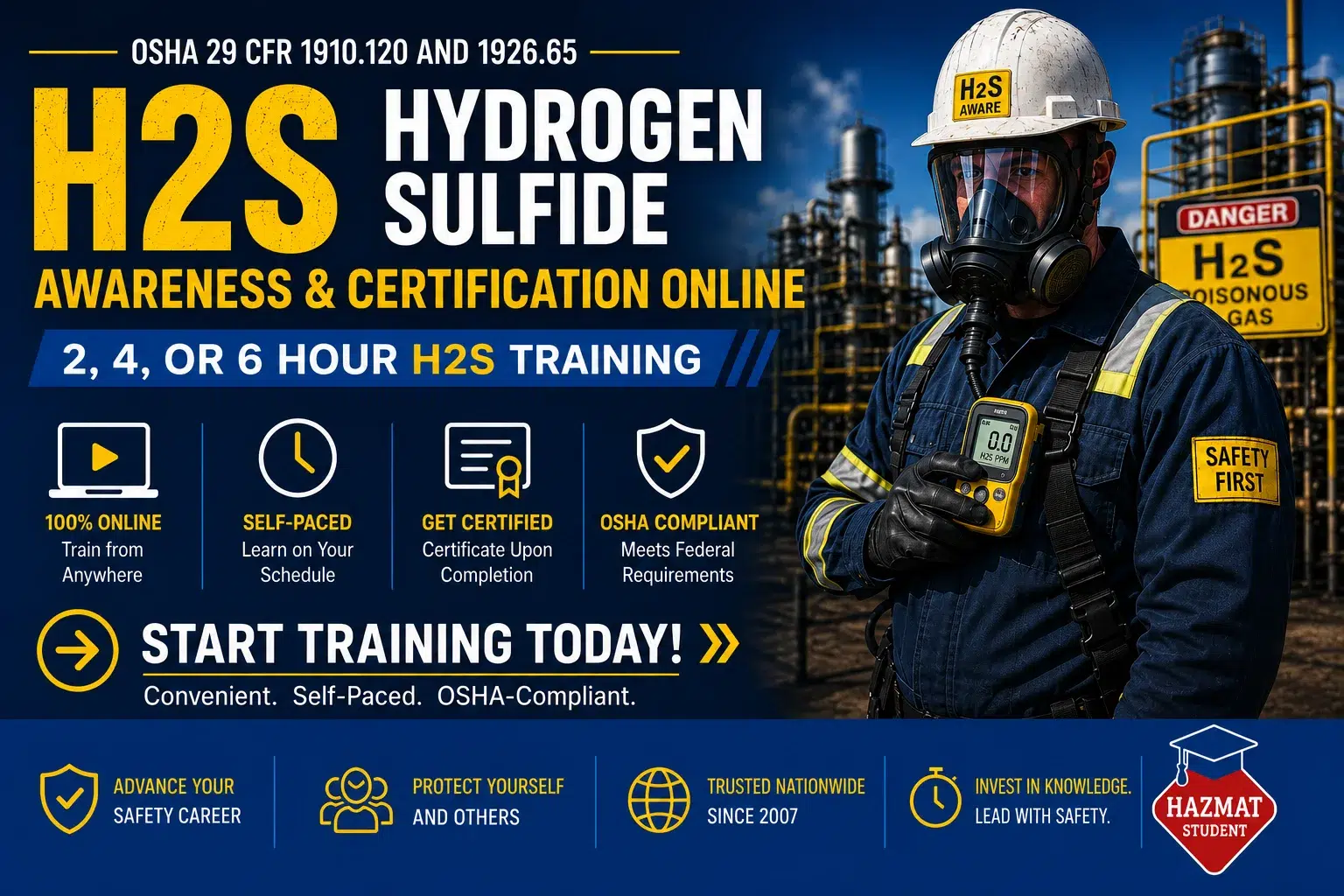
H2S Awareness Training Online
OSHA-aligned hydrogen sulfide training built around 29 CFR 1910.1000 Table Z-2 and ANSI Z390.1. Three tiers to match your employer or contractor requirement. Self-paced, instant certificate, accepted by oilfield operators nationwide.
What Is H2S Awareness Training?
H2S awareness training teaches workers about the hazards of hydrogen sulfide gas, a highly toxic, colorless, "rotten egg" smelling gas commonly encountered in oil and gas, wastewater treatment, pulp and paper mills, sewers, and confined-space operations. Training covers OSHA permissible exposure limits under 29 CFR 1910.1000 Table Z-2, health effects at each exposure level, monitoring equipment, respiratory protection, and emergency rescue procedures. HazMat Student offers three H2S course tiers starting at $19.95. Pick the one that matches what your employer or site requires. The 2-Hour OSHA tier is also available fully in Spanish.
The Federal Regulatory Framework for H2S
OSHA enforces H2S exposure limits under 29 CFR 1910.1000 Table Z-2 for general industry, 29 CFR 1926.55 for construction, and 29 CFR 1915.1000 for shipyards. NIOSH provides recommended exposure limits and IDLH guidance. The industry consensus standard for H2S training is ANSI Z390.1, included in our 4-hour and 6-hour tiers.
What Each H2S Course Covers
- Properties and chemistry of hydrogen sulfide
- Health effects from low-level to fatal exposure
- OSHA PELs, ceiling, peak, and IDLH limits
- H2S monitoring and detection equipment
- Respiratory protection and SCBA basics
- Emergency response and rescue procedures
Who Needs H2S Training
- Oil & gas exploration, production, refining
- Wastewater treatment plant operators
- Sewer, lift station, and confined-space workers
- Pulp and paper mill workers
- Agricultural workers (manure pits, silos)
- Contractors entering H2S-classified sites
Complete Your H2S Program
- Pair with Benzene Awareness for refinery and midstream crews
- Add 40-Hour HAZWOPER for site remediation work
- Check H2S requirements in your state to see who enforces locally
- Schedule SCBA fit testing and hands-on rescue drills in person with your employer
- Browse the full Chemical-Specific Training catalog
3 H2S Course Tiers. Which One Do You Need?
All three tiers issue an instant digital certificate. The Wallet ID Card is a $5 option you select during enrollment on any tier, which brings the price to $24.95, $34.95, or $44.95. Choose the tier matching your employer or site requirement. When in doubt, the 4-Hour OSHA/ANSI satisfies the broadest range of oilfield contractor pre-qualification systems. Language note: only the 2-Hour OSHA tier is offered in Spanish. The 4-Hour and 6-Hour OSHA/ANSI tiers are English only. See Course Language Availability below.
2-Hour OSHA H2S Awareness
or $24.95 with the optional Wallet ID Card, selected at enrollment
🌐 English + Español- OSHA 29 CFR 1910.1000 Table Z-2 baseline
- Hydrogen sulfide properties & health effects
- PEL, ceiling, peak exposure limits
- Detection & monitoring basics
- Respiratory protection overview
- Digital certificate, mobile-ready
- Available in Spanish
- ANSI Z390.1 not included
4-Hour OSHA/ANSI H2S Awareness
or $34.95 with the optional Wallet ID Card, selected at enrollment
🌐 English only- Everything in 2-Hour tier
- ANSI Z390.1 compliance
- Detailed detection equipment training
- SCBA & escape respirator procedures
- Site evacuation & rescue protocols
- Contractor pre-qualification accepted
- Best fit for most oilfield contractors
- Not available in Spanish
6-Hour OSHA/ANSI H2S Certification
or $44.95 with the optional Wallet ID Card, selected at enrollment
🌐 English only- Everything in 4-Hour tier
- Full ANSI Z390.1 certification
- Expanded rescue procedures
- Multi-gas atmosphere monitoring
- Detailed case studies & incident analysis
- Strictest operator requirements satisfied
- Most comprehensive tier available
- Not available in Spanish
Course Language Availability
We want this to be unambiguous before you pay. Only the 2-Hour OSHA H2S Awareness course is delivered in Spanish. The 4-Hour OSHA/ANSI Awareness and 6-Hour OSHA/ANSI Certification courses are currently delivered in English only, including the narration, the student manual, and the final exam. If your operator or contractor requires ANSI Z390.1, the qualifying course has to be completed in English at this time.
2-Hour OSHA H2S Awareness
Fully narrated in Spanish with a Spanish student manual and exam. Same price as the English version. Ver el curso en español
4-Hour OSHA/ANSI H2S Awareness
English only. This is the tier most oilfield operators require for ANSI Z390.1, so plan for English delivery if your crew needs Z390.1 documentation.
6-Hour OSHA/ANSI H2S Certification
English only. The full Z390.1 certification tier, including expanded rescue and multi-gas monitoring content, is not currently offered in Spanish.
¿Necesita capacitación de H2S en español?
Queremos ser claros antes de que usted pague. Esto es lo que ofrecemos actualmente en español:
- Curso de 2 horas de Concientización sobre Sulfuro de Hidrógeno (H2S) de OSHA: disponible totalmente en español por $19.95, o $24.95 con la Tarjeta de Identificación opcional. Incluye narración, manual del estudiante y examen final en español.
- Curso de 4 horas OSHA/ANSI Z390.1: disponible únicamente en inglés.
- Curso de 6 horas de Certificación OSHA/ANSI Z390.1: disponible únicamente en inglés.
Si su empresa o el operador del campo petrolero exige el estándar ANSI Z390.1, el curso que cumple ese requisito (4 horas o 6 horas) debe completarse en inglés por el momento. Si tiene preguntas, llámenos al 1-888-342-9628 o escríbanos y con gusto lo orientamos.
Working a site where ANSI Z390.1 is required and your crew reads Spanish?
Call us at 1-888-342-9628 before you enroll. We will tell you plainly what is and is not available in Spanish, and we can help you document the English-language Z390.1 completion for your operator's pre-qualification file. We would rather lose the sale than have your crew turned away at the gate.
OSHA H2S Exposure Limits: What You Will Learn
Every H2S course at HazMat Student teaches the federal exposure limits that govern your workplace. Knowing these numbers can save your life, because H2S overwhelms your sense of smell at concentrations far below the lethal threshold, so you cannot rely on odor alone.
Source: OSHA Hydrogen Sulfide Standards (osha.gov) and OSHA Oil and Gas eTool, H2S Monitoring. Industry practice typically uses 10 ppm as the alarm setpoint to warn workers and trigger evacuation. The NIOSH Recommended Exposure Limit (REL) is 10 ppm 10-minute ceiling. The ACGIH TLV is 1 ppm 8-hour TWA with a 5 ppm STEL.
The "olfactory fatigue" trap
H2S smells like rotten eggs at low concentrations, but at 100 ppm and above the gas paralyzes your olfactory nerves. Workers literally stop smelling H2S right when the gas becomes lethal. This is why detection equipment, not your nose, is the only reliable warning. Every H2S course at HazMat Student covers this directly.
Where H2S Training Is Required
H2S exposure is a regulated hazard across multiple industries, with oil and gas leading the demand. Each industry has its own contractor pre-qualification system and site-access requirements, and most require the 4-Hour OSHA/ANSI or 6-Hour Certification tier. Exposure limits are federal and identical nationwide, but enforcement differs depending on whether your state runs its own OSHA State Plan. See H2S Awareness Training by State for the jurisdiction and dominant H2S industries where you work.
⚙ Oil & Gas
- Drilling and well servicing (per OSHA's Oil & Gas eTool)
- Refinery operators and tank crews
- Pipeline inspection and maintenance
- Midstream gas processing facilities
🚰 Wastewater & Sewer
- Municipal wastewater treatment plants
- Industrial pretreatment facilities
- Lift station and pump house operations
- Confined-space sewer entry crews
🏭 Pulp, Paper & Process
- Kraft pulping operations
- Chemical recovery boilers
- Black liquor handling
- Process tank maintenance
🛣 Confined Space
- Tank entry and vessel inspection
- Underground vault work
- Permit-required confined spaces
- Rescue team support roles
🌾 Agriculture
- Manure pit and lagoon operations
- Silo entry and grain bin work
- Livestock confinement facilities
- Anaerobic digester operations
🚑 Emergency Response
- Industrial spill response teams
- HazMat technician support
- Mutual aid fire department crews
- Plant emergency response personnel
How to Enroll and Complete H2S Training
-
Verify your employer or site requirement
Ask your safety officer or contracting company which tier they require. Most major oilfield operators (refineries, midstream, E&P) require ANSI Z390.1, which is included in our 4-Hour OSHA/ANSI and 6-Hour Certification tiers. If you also want to know who enforces H2S rules where you work, look up your state first.
-
Confirm the language you need
The 2-Hour OSHA tier is offered in English and in Spanish. The 4-Hour and 6-Hour OSHA/ANSI tiers are offered in English only. If ANSI Z390.1 is required, plan on completing that course in English.
-
Pick your tier above
2-Hour OSHA ($19.95) for baseline awareness, 4-Hour OSHA/ANSI ($29.95) for most oilfield contractor work, or 6-Hour OSHA/ANSI Certification ($39.95) for the strictest operator requirements.
-
Decide on the Wallet ID Card
The optional physical PVC card adds $5 to any tier. It is not a separate class. You choose it during enrollment by selecting the matching "with Wallet ID Card" course line. Some employers require it for field access, and many workers prefer it for verification on multi-employer sites. The digital certificate is included free with every tier.
-
Enroll through the OTS portal
Click Enroll Now from your chosen tier above. After logging in, click Signup for Course, search for Hydrogen Sulfide, then select the course line that matches your tier, language, and Wallet ID Card preference. Corporate accounts are available for group enrollment.
-
Complete the self-paced course
Log in from any device. The course is self-paced, so you can log in and out as needed and progress saves automatically. Most workers complete the 2-hour course in a single session.
-
Pass the exam and download your certificate
Complete the final exam. When you pass, your digital certificate and printable transcript are immediately available in your student account. Wallet ID Cards, if ordered, ship separately by mail.
When H2S Training Pays Off: 4 Scenarios
H2S training is not paperwork. It directly governs whether a worker can enter a site, respond to an alarm, or rescue a downed coworker without becoming the second casualty. Four scenarios from the field.
🎯 Scenario 1: The Refinery Gate
A welding contractor arrives at a Texas refinery Monday morning for a 3-week tank-cleaning project. The refinery safety officer pulls training records before site entry. Workers have HAZWOPER and HazCom, but their H2S training is the 2-hour OSHA course. The refinery requires ANSI Z390.1.
What Is at Stake: Missing H2S Training Is Expensive
H2S is one of OSHA's most aggressively enforced exposure standards because deaths happen quickly and rescuer fatalities compound the toll. A single untrained worker on an H2S-classified site is a textbook citation, and the penalty math compounds across crews.
OSHA's current maximum penalty for a serious H2S training violation, assessed per violation. Effective January 15, 2026 and adjusted annually for inflation.
Willful or repeat violations carry a maximum of $165,514 per violation. Knowing a site is H2S-classified and not training workers is exactly what willful citations look like.
Operators and contractors can halt H2S-classified work until training is documented. ISN, Avetta, and PEC systems flag missing H2S records automatically.
When untrained workers die from H2S exposure, criminal referrals to DOJ are routine. The $20 awareness course is the cheapest insurance policy a safety program can buy.
Source: OSHA Penalties (osha.gov) and the OSHA memorandum of May 21, 2026 on annual adjustments to civil penalties. Penalty maximums are adjusted annually under the Federal Civil Penalties Inflation Adjustment Act Improvements Act of 2015. The current maximums took effect January 15, 2026. Penalties are assessed per violation, not per inspection.
The rescue fatality multiplier
NIOSH data consistently shows that 60 to 70 percent of H2S workplace deaths involve attempted rescue by a coworker who also dies. One downed worker becomes two, sometimes three. Training that drills "do not enter without SCBA" prevents this single most preventable pattern in H2S fatalities. The math: $20 training for 3 workers is $60. The alternative is three families and three OSHA fatality investigations.
7 Common H2S Training Mistakes
After nearly two decades training H2S workers and employers, these are the failure patterns we see most often, along with the simple fix for each.
Why Oil & Gas Safety Managers Choose HazMat Student for H2S
HazMat Student has delivered online H2S training since July 2007, through three OSHA penalty inflation cycles and the entire Permian and Eagle Ford boom-bust cycle. Safety managers return year after year for the breadth of tier options, the price, and the reliability of the certificate.
Honest scope, including language
We say plainly which tier satisfies which requirement, and which tier exists in which language. The 2-hour course is baseline OSHA awareness and is the only tier offered in Spanish. The 4-hour and 6-hour tiers add ANSI compliance and are English only. No marketing fog. That clarity protects you at the gate.
Training a Crew for H2S-Classified Work?
Safety managers use HazMat Student to enroll oil & gas, wastewater, and confined-space crews in any of our three H2S tiers through a single corporate account, with one invoice, one dashboard, and one training record per worker. Mixed-language crews are welcome, and we will tell you up front which tiers exist in Spanish. Running crews across state lines? Every certificate is portable, and H2S Training by State breaks down the jurisdiction for all 50 states. Pairs naturally with our Benzene course for refinery and midstream work.
Call us: 1-888-342-9628
Frequently Asked Questions: H2S Awareness Training
H2S awareness training teaches workers about the hazards of hydrogen sulfide gas, a highly toxic substance commonly encountered in oil and gas, wastewater treatment, pulp and paper, sewer work, and confined-space operations. Training covers OSHA permissible exposure limits under 29 CFR 1910.1000 Table Z-2, health effects at each exposure level, monitoring equipment, respiratory protection, and emergency rescue procedures.
Only the 2-Hour OSHA H2S Awareness course is available in Spanish. It is delivered fully in Spanish, including narration, student manual, and final exam, for $19.95, or $24.95 with the optional Wallet ID Card. The 4-Hour OSHA/ANSI H2S Awareness course and the 6-Hour OSHA/ANSI H2S Certification course are currently offered in English only. If your operator or contractor requires ANSI Z390.1 compliance, that qualifying course must be completed in English at this time. View the Spanish H2S course or call 1-888-342-9628.
En español: Solo el curso de 2 horas de Concientización sobre Sulfuro de Hidrógeno (H2S) de OSHA está disponible en español, por $19.95, o $24.95 con la Tarjeta de Identificación opcional. Los cursos de 4 horas y 6 horas OSHA/ANSI Z390.1 se ofrecen únicamente en inglés. Ver el curso en españolThe 2-Hour OSHA course meets basic OSHA awareness requirements at $19.95 and is the only tier offered in Spanish. The 4-Hour OSHA/ANSI course adds compliance with ANSI Z390.1, the industry consensus standard required by most oilfield, refinery, and pipeline operators, at $29.95. The 6-Hour OSHA/ANSI Certification is the most comprehensive tier, satisfying the strictest contractor and operator requirements at $39.95. Check your employer's specific training requirements before enrolling.
Most major oilfield operators (refineries, midstream, exploration and production companies) require ANSI Z390.1-compliant training, which is delivered in our 4-Hour OSHA/ANSI and 6-Hour OSHA/ANSI Certification tiers. The 2-Hour OSHA course meets baseline awareness but may not satisfy specific contractor pre-qualification requirements like ISN, Avetta, or PEC Premier. Both ANSI Z390.1 tiers are currently English only. Always verify with your site safety officer or contracting company before enrolling.
For general industry, OSHA enforces a 20 ppm ceiling limit and a 50 ppm peak limit (allowed for no more than 10 minutes per 8-hour shift, only if no other measurable exposure occurs) under 29 CFR 1910.1000 Table Z-2. For construction (29 CFR 1926.55) and shipyards (29 CFR 1915.1000), the PEL is 10 ppm time-weighted average. NIOSH recommends a 10 ppm 10-minute ceiling and sets the Immediately Dangerous to Life or Health (IDLH) at 100 ppm.
ANSI Z390.1 is the American National Standard for Accepted Practices for Hydrogen Sulfide (H2S) Training Programs. It is the industry consensus standard widely required by oil and gas operators, refineries, and pipeline companies because it goes beyond OSHA's baseline requirements with specific provisions for detection equipment, breathing apparatus, evacuation procedures, and rescue. Our 4-hour and 6-hour courses include ANSI Z390.1 content and are offered in English only.
OSHA can cite employers up to $16,550 per violation for serious training violations. Willful or repeat violations carry a maximum of $165,514 per violation. These maximums took effect January 15, 2026 and are adjusted annually for inflation. Untrained workers exposed to H2S in oil and gas, wastewater, or confined-space operations are a routine source of citations. Current penalty schedule: osha.gov/penalties.
ANSI Z390.1 requires annual refresher training. Many employers also require annual refresher under their site-specific safety programs. OSHA does not specify a renewal interval in 29 CFR 1910.1000, but most operators and contractors enforce annual training as a contract or site-access requirement. Calendar the renewal 60 days before due.
The Wallet ID Card is an optional physical PVC card with your name, photo, certification details, and issue and expiration dates. It is not a separate course. It is a $5 add-on you select during enrollment on any tier, bringing the price to $24.95, $34.95, or $44.95. In the OTS portal you simply choose the course line that includes "with Wallet ID Card." Some employers require the physical card for field access, and many workers prefer it for quick verification on multi-employer sites. The standard digital certificate is included free with every tier.
The 2-Hour OSHA course averages about 2 hours. The 4-Hour OSHA/ANSI course averages about 4 hours. The 6-Hour OSHA/ANSI Certification averages about 6 hours. All courses are self-paced, so you can log in and out as needed. Progress saves automatically. Most workers finish in a single session.
HazMat Student's H2S courses are accepted by oilfield contractors, refineries, midstream operators, wastewater plants, and industrial employers nationwide. Each tier issues a digital certificate suitable for contractor pre-qualification systems (ISN, Avetta, PEC Premier) and site-access verification. Always verify your specific operator's training requirements, since most require the 4-hour OSHA/ANSI or 6-hour Certification tier.
Related Courses & Authoritative H2S Resources
Get H2S Certified Today
Trusted by oil & gas, wastewater, and confined-space crews nationwide since July 2007.
Pick your tier from $19.95. 100% online, self-paced, instant certificate. ANSI Z390.1 is included in the 4-hour and 6-hour tiers.

